
Working Group "Vacancy Management“
Members
LeerGut-Agenten | LAG Soziokultur e. V. | Thuringian State Chancellery | Thuringian Ministry for Digital Affairs and Infrastructure | Thuringian Ministry for Economic Affairs, Agriculture and Rural Areas | Association of Municipalities and Cities of Thuringia e. V. | City of Bad Liebenstein | City of Gotha | City of Gera | City of Pößneck | Thuringian Development Bank | Association of Thuringian Housing and Real Estate Industry e. V. | Erfurt Chamber of Industry and Commerce | East Thuringia Chamber of Industry and Commerce | Quartiere für Alle e. V.
What does the working group do?
The development of solution approaches and strategies to tackle vacancies in city centres and town centres is the core of the group's work. Different expertise and perspectives are taken into account and vacancy is understood as an opportunity that must be boldly seized. No fear of change – but engagement for innovation. These are the guidelines of the operational work of all actors, daily in their respective area of effect and together within the framework of the Thuringian-wide action alliance.
Goals
The working group pursues the goal of developing solutions for various vacancy typologies through constructive discourse. This includes, for example, vacancies in retail spaces in pedestrian zones, vacant inns in town centers, or other vacant residential and commercial buildings. Cooperation within municipalities, in conjunction with civil society actors, is to be promoted and is incorporated into the work of the working group.
By the end of 2024, the working group aims to initiate two pilot projects and bring them to implementation. A first starting point here is the development of a collection of best-practice examples that document different strategies for managing vacancies and are intended to serve as inspiration for replication as well as provide guidance. Existing experience values are to be made usable for other active parties, municipalities, and civil society, and a practical aid for the reactivation of vacancies is to be created.
Results of the working group
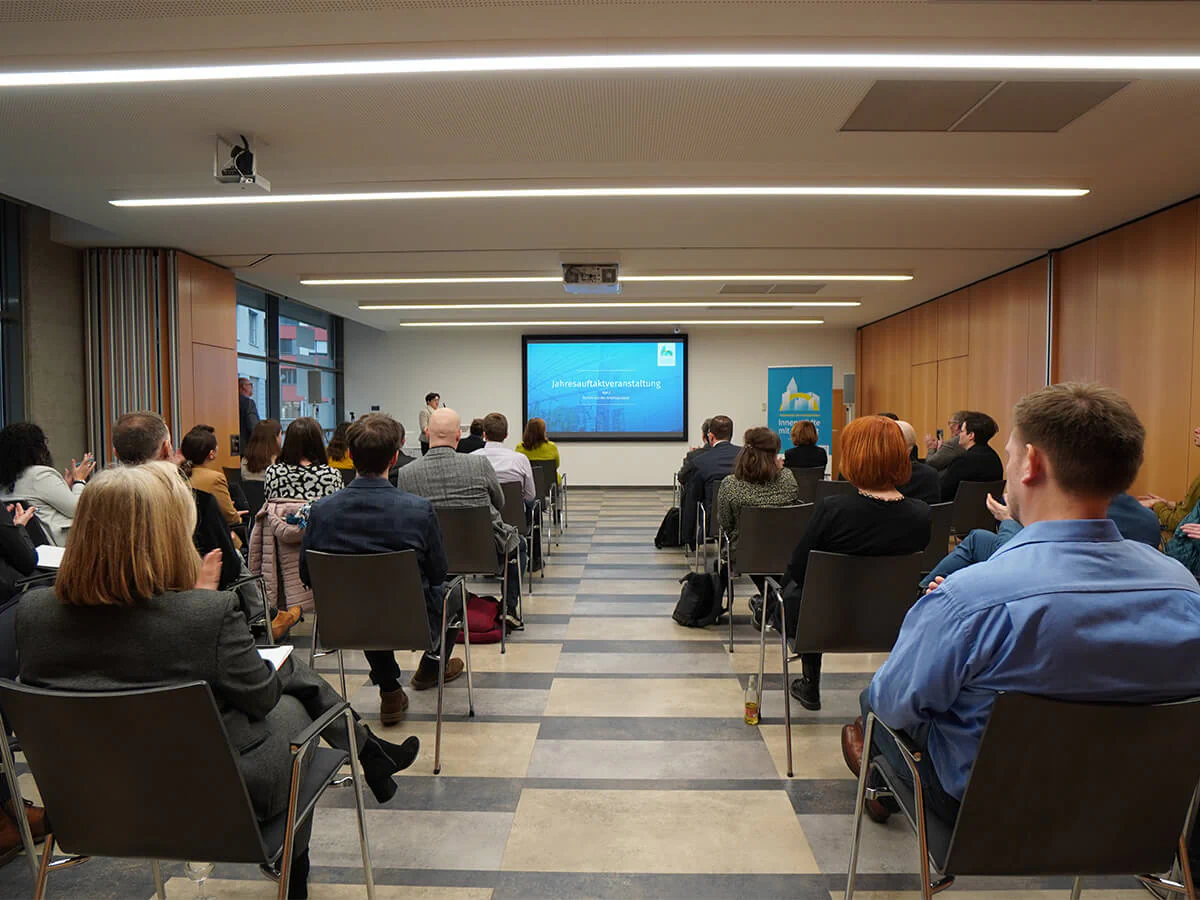
“Using vacancy as an opportunity – developing joint solutions”: This was the motto of the 3rd transfer event “Thinking together & acting together”, to which the Thuringian Ministry of Infrastructure and Agriculture had invited to Apolda in November 2022. The Working Group on Vacancy Management contributed competence and know-how to the conception and implementation of the experimental event. Municipal and state administration as well as civil society actors worked co-productively on case studies of urban development and vacancy activation. It became apparent that creativity and civic engagement create livable places when space and opportunities for exchange are provided.
Further information
Living and life in the city
The sustainable strengthening of the functionality of Thuringia's city centers is a central goal of the working group's efforts within the action alliance. The working group is working on the development of pilot projects and measures with a model character that are intended to be applicable in Thuringia's large, medium, and small towns.
Climate
The main goals of the working group are to ensure comprehensive knowledge transfer and to develop pilot projects for climate adaptation and climate protection measures. Accordingly, the quality of life and stay in the city is a particular focus.