
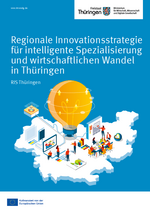
Innovation Strategy
In recent years, Thuringia has developed into a strong innovation region. The current Regional Innovation Scoreboard 2025 of the European Union distinguishes the innovation and research location Thuringia as a “strong innovator”.
Innovation policy is increasingly expected to provide answers to many pressing questions: in societal and social issues as well as for public services and participation, decarbonization and climate change, demographics and aging.
Innovative answers to these questions can come from science and research, as well as from the entrepreneurial and social environment. This includes impulses for technological innovations and innovative improvements to products and processes, as well as rethought business models, organizational forms, and services.
Regional innovation strategy in the funding period 2021-2027
The foundation has been laid: With the "Regional Research and Innovation Strategy for Intelligent Specialization for Thuringia for the funding period 2014 to 2020“, the Thuringian state government has created a cooperation and coordination platform for the various actors in the innovation location Thuringia. This will also be built upon in the current funding period. Consequently, it is now about focusing on the specialization fields that have particularly high future potential.
The five Thuringian Specialization Fields

Industrial production and systems

Sustainable and intelligent mobility and logistics

Healthy living and health economy

Sustainable Energy and Resource Use

ICT, innovative and production-oriented services
The Regional Innovation Strategy in the funding period 2021 to 2027 aims to drive the development of the five specialization fields through a multi-stakeholder approach. In addition to innovation drivers such as universities, non-university research institutions, and business enterprises, other actors also contribute to the development of the specialization fields: cluster and network organizations, business-oriented research institutions and innovation centers, as well as multipliers such as economic and industry associations. All these actors simultaneously serve as links between research and application, and between innovation actors and political institutions such as the state government.
Improve structures, strengthen processes
Implementation of the innovation strategy
In the sense of a sustainable cluster policy, we strengthen the Cross-cluster approach. This means that, in addition to the five specialization fields, we also place great emphasis on differentiation within the fields. From the multitude of topics and activities, we crystallize highlights that can be developed into innovative value creation networks. The focus is on those nodes of the supply and service chains that offer high potential and are strategically particularly relevant for Thuringia in the sense that:
- Specialization advantages for Thuringia are identifiable,
- there are sufficient scientific and/or economic actors who have built up competencies over years,
- there is a high application relevance to innovative solution approaches for future challenges and
- high future and growth potential exists.
From the need for action to the roadmap
As part of an intensive dialogue and participation process, the following topics were initially identified: “Personalised Health“, “Production rethought: efficient, sustainable, resilient“, “Sustainable Mobility and Logistics for Rural Areas“, “Resilient Digital Ecosystems“ and “Sustainable Construction and Renovation“
These topics are at the interfaces of industries, technologies and future issues and offer innovative solutions in response to current socio-economic and ecological challenges. In a further step, we identify and prioritize the need for action and bottlenecks for the development of the topics.
Involving Thuringian stakeholders, we examine where concrete approaches for innovation-based value creation networks in line with cluster policy emerge and develop roadmaps for these. These roadmaps are intended to derive fields of action for the respective network and identify concrete measures for the participating stakeholders.
RIS Governance Structure
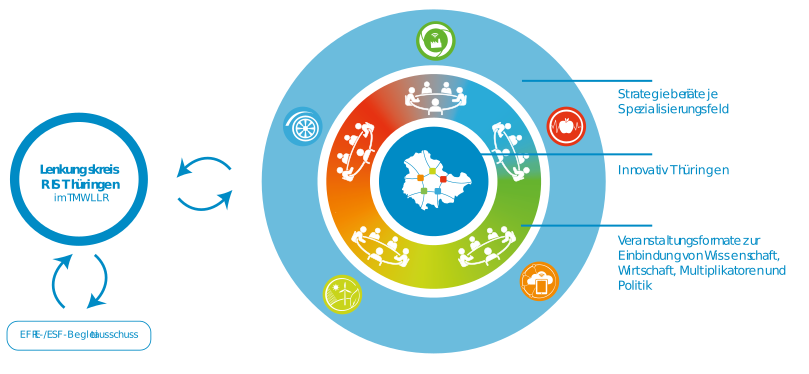
We connect the innovation players in Thuringia and strengthen the trusting exchange between the participants through our work. In doing so, we particularly take on the process- and participation-oriented implementation of the "Regional Innovation Strategy for Smart Specialization and Economic Change in Thuringia". As the RIS office and an important partner in strategy implementation, we will in future bear greater responsibility for the conception and development of the specialization fields on behalf of the TMWLLR.
Strategy Advisory Boards – Event Formats – Steering Committee
We are supported in this by the Strategy Advisory Boards. The TMWLLR has appointed more than 80 Thuringian experts from business, science, as well as clusters and networks for this purpose. The strategic advisory boards contribute an overarching and content-related strategic component from an application and development perspective to the respective fields. For each specialization field, a strategic advisory board is active, which has elected a spokesperson and a deputy from among its members.
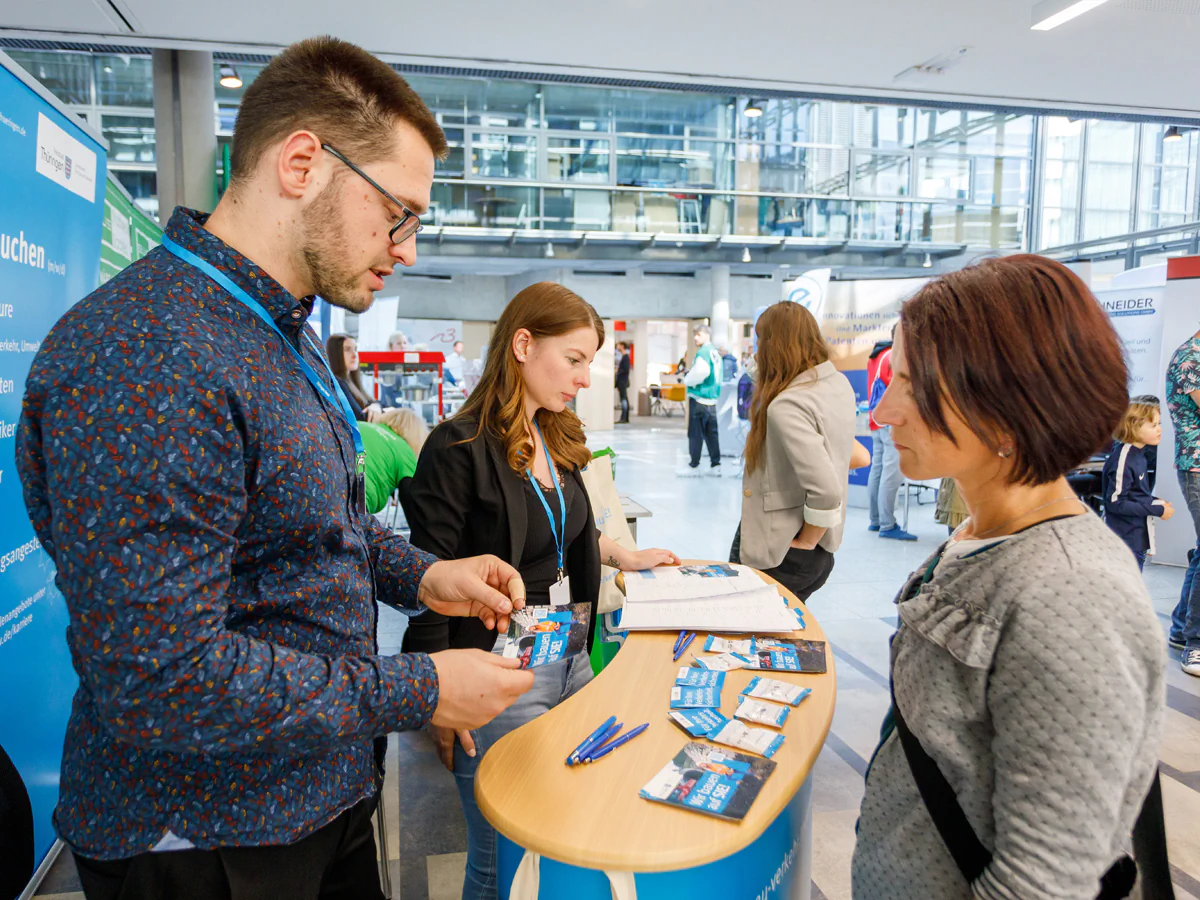
To actively involve universities, research institutions, innovation centers, companies, networks and other stakeholders, we also rely on our own, specially developed Event formats. They create space for exchange, cooperation and new ideas – with a noticeable broad impact.
The monitoring and steering of strategy implementation as well as the advisory on our tasks are the responsibility of the RIS Steering Committee, under the leadership of the TMWLLR. The Steering Committee includes representatives of the TMWLLR departments relevant to the RIS context, ourselves as the RIS Office, the Thüringer Aufbaubank, as well as the spokespersons and their deputies of the RIS Strategy Advisory Boards. Through active reporting, the Steering Committee ensures transparent connectivity to the responsible ministries and state institutions. It also meets regularly to accompany and coordinate the diverse implementation processes of RIS Thüringen. Furthermore, feedback with representatives of the economic and social partners on the use of EU structural aid within the framework of the implementation of RIS Thüringen is provided via the reporting of the RIS Steering Committee to the ERDF/ESF Monitoring Committee.
Monitoring of strategy implementation
Monitoring of strategy implementation
The implementation of the innovation strategy is accompanied by monitoring. The core of the monitoring is the observation of activities for implementing the strategy and achieving the set goals. The coordination of the monitoring is the task of Innovativ Thüringen in its function as the RIS office in cooperation with the TMWLLR and other partners. The evaluations of the monitoring are published as factsheets.
Current evaluations
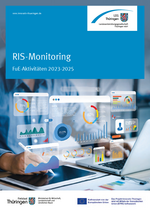
RIS Monitoring R&D Activities 2023-2025
(Document is not barrier-free)
RIS Monitoring R&D Activities 2023-2025
RIS-Monitoring: Innovation-supporting Activities 2022-2024
(Document is not barrier-free)
RIS-Monitoring: Innovation-supporting Activities 2022-2024
RIS-Monitoring Impact Indicators 2021-2023
(Document is not barrier-free)
RIS-Monitoring Impact Indicators 2021-2023
Thuringia Innovation Survey
The Thuringia Innovation Survey records the innovation activities of Thuringian companies in a nationally and internationally comparable form. Since 2024, it has been conducted by the Leibniz Centre for European Economic Research (ZEW) on behalf of LEG Thüringen as an additional survey to the annual German Innovation Survey. This allows the results for Thuringia to be directly compared with those of Germany and the other East German states. The survey complements the accompanying monitoring of the Thuringian Innovation Strategy and supports its evaluation.