
Foresight Report - Cycle I Authoren: Innovativ Thüringen & Institute for Innovation and Technology (iit) at VDI/VDE Innovation + Technik GmbH
Published: November 2025
1. Why Foresight?
Thuringia faces the challenge of making its innovative strength future-proof in an environment characterized by technological, social, and geopolitical upheavals, and of using the available resources and potentials as effectively as possible. The question of how the future can be actively shaped is of central importance for decision-makers in politics, business, and science, as priorities must be set. In a time of profound technological and social transformations, strategic foresight serves to generate orientation knowledge about possible future developments. Innovativ Thüringen launched a foresight process in 2024 that systematically, data-based, and participatively identifies central future topics for Thuringian innovation policy and anticipates their consequences. This process is to be repeated annually. Foresight (Strategic Foresight) refers to a systematic, knowledge-based process for anticipating possible future developments in order to generate orientation knowledge for strategic decisions at an early stage and to identify actionable options. The goal of the process in Thuringia is to identify relevant trends in order to make long-term decisions on a reliable knowledge base and to open up future development paths for the Thuringian innovation landscape.
Within the framework of the Regional Innovation Strategy for Smart Specialisation and Economic Change in Thuringia (RIS Thuringia), foresight constitutes a central element of governance and further development. Strategic foresight enables the systematic identification of technological, economic and societal future trends and their transfer into structured innovation pathways. Through the use of foresight instruments, fields of action are identified at an early stage in which Thuringia can combine existing strengths with emerging opportunities. In this way, within the RIS, foresight helps not only to address innovation potential reactively, but to proactively unlock it and to shape resilient strategies for research, development and value creation.
This report provides an overview of the foresight process and the results of the first foresight cycle, which was conducted from June 2024 to June 2025 by Innovativ Thüringen as a shoulder check with the Institute for Innovation and Technology (iit) at VDI/VDE Innovation + Technik GmbH and is now being continued on an ongoing basis.
2. Foresight process in Thuringia
A central element of the foresight activities is ongoing trend analysis and monitoring, which is carried out by the Foresight Team are carried out by Innovativ Thüringen at the Landesentwicklungsgesellschaft Thüringen mbh (LEG Thüringen). In the recurring foresight process, quantitative analyses are combined with qualitative assessments, and actors from science, business, and administration are specifically involved. The core of the process is the identification of trends that are not only technologically relevant but also open up strategic design spaces for Thüringen. The foresight cycle envisions that futures are anticipated, business model patterns are derived, transfer potentials are identified, and project proposals are developed together with relevant stakeholders.
Thuringia brings excellent prerequisites to actively shape future developments. The innovation landscape is characterized by short distances, a high-performance cluster ecosystem, a high degree of specialization among companies, and a strong research infrastructure. Thuringia also already has a number of relevant networks and innovation formats that strengthen value creation. Existing competencies in areas such as sensor technology, image processing, energy, and medical technology make it possible to systematically occupy specific niches and open up new value creation paths.
The foresight process for Thuringia was developed in close cooperation with the foresight experts of the Institute for Innovation and Technology (iit) at VDI/VDE Innovation + Technik GmbH. In a multi-stage procedure, relevant trends for Thuringia are identified, paths of possible future developments are anticipated, and areas of action for the Thuringian innovation landscape are recognized. Particular emphasis is placed on a data-based and scientifically valid approach. The process follows a multi-stage procedure (see figure).
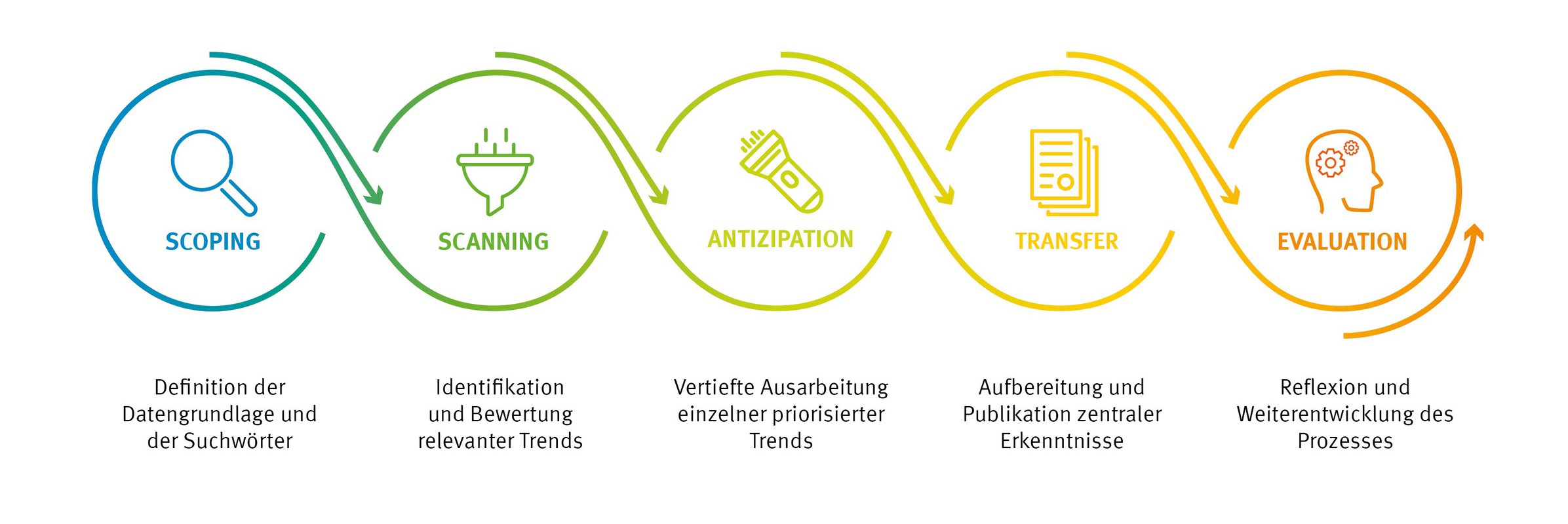
In the scoping phase, the search space and search strategy are defined, i.e., the systematics used to search for relevant technology trends for the innovation location Thuringia. In the scanning phase, trend data are then analyzed according to the defined search strategy and condensed into trends with particularly high relevance for Thuringia through a combination of data analysis and expert assessment. The identified trends are then analyzed in depth in the anticipation phase using qualitative foresight methods to examine how these trends will develop in the coming years and what potential they could have for the Thuringia location. The results of each cycle are communicated in the transfer phase through reports, keynote presentations, and workshops, and transferred to Thuringia's politics, business, and science. This process is carried out once a year (foresight cycle). Before entering the next foresight cycle, an evaluation of the procedure and an adjustment of the study design take place.
3. Approach and Methods
3.1 Scoping
At the beginning of the scoping phase in the first cycle of 2024, the search space in which trend topics are to be searched was defined. This was initially narrowed down thematically. The basis for the thematic delimitation is formed by the five specialization fields already established in the RIS Thüringen. These include: Industrial production and systems, Sustainable and intelligent mobility and logistics, Healthy living and health economy, Sustainable Energy and Resource Use, ICT, innovative and production-oriented services. In close cooperation between the iit's foresight experts and the foresight team and the specialization field managers of Innovativ Thüringen, the data sources to be collected and the search strategies required for data analysis were defined for each specialization field.
The data selection was made according to the underlying research interest. Innovativ Thüringen pursues a threefold objective in connection with the RIS Thuringia a threefold objective: (1) strengthening the transfer of new scientific findings from research into marketable products and services, (2) strengthening the competitiveness of the Thuringia location, e.g. through cross-sector and cross-technology-field value creation networks, and (3) increasing the visibility of the economic and innovation location and strengthening supra-regional networking.
This results in the following requirements for the selection of the data basis:
- Identify the latest scientific research findings as early as possible.
- Identify interface topics across different sectors (including data on pre-competitive trends and trends already in application)
- Identify driving actors behind trends for (i) differentiation potential (Where are Thuringian actors in competition?) and (ii) cooperation and networking potential (Where can actors from Thuringia cooperate with supra-regional actors in a specific field?)
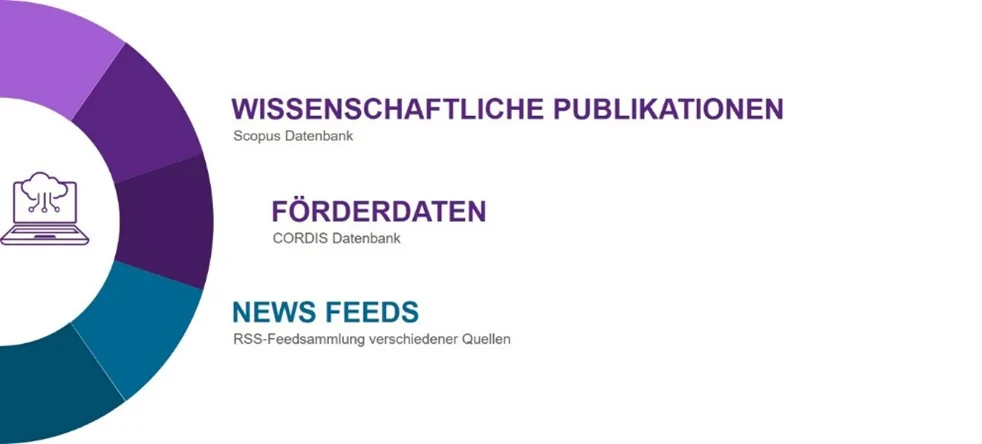
For the analysis, scientific conference papers from the Scopus® literature database, funded projects at the European level in the CORDIS database, and RSS feeds from news blogs were used in the first cycle (see figure). A total of 151,433 conference papers, 5,909 funded sub-projects of European research consortia, and 97,882 news articles were evaluated.
3.2 Scanning
During the scanning phase, relevant data sources were systematically searched, processed in terms of content, and thematically condensed in order to identify initial development lines and focal points. The resulting topic clusters were gradually consolidated, qualitatively analyzed, and evaluated by experts according to defined relevance criteria. Based on this evaluation, central key trends were derived, which were discussed in depth in the subsequent trend workshop and classified with regard to their strategic importance for Thuringia.
Quantitative Data Analysis
- Using the developed search strings, the data sources described above were searched and corresponding data sets (samples) were generated for the respective specialization fields. These samples of potentially relevant data sets were processed using text mining procedures to enable further evaluation. To analyze these relationships, a word embedding method (Word2Vec) from the field of Natural Language Processing (NLP) was used. The resulting word vectors form a high-dimensional semantic space in which contextually related terms are close to each other. This enables an aggregated view of the contained topic complexes.
- To explore the emerging vector space, a k-means clustering method was used. K-means clustering is an unsupervised pattern recognition method in which data elements are grouped into clusters (k) based on their similarity. The goal is to achieve the highest possible similarity within clusters and the greatest possible difference between clusters. In this way, semantically similar terms could be grouped into clusters and visualized in the form of topic maps. These allow an aggregated representation of overarching subject areas.
- Finally, the thematic clusters were transformed using Principal Component Analysis (PCA) for a spatial representation. PCA is a dimensionality reduction method that maps high-dimensional data onto a few principal components through linear transformation. This enabled a two- or three-dimensional mapping of the semantic space as well as a spatial representation of the clusters, thereby making content overlaps between the clusters and thematic relationships visible.
Qualitative Elaboration
- The topic clusters developed in this way were subsequently analyzed in greater qualitative depth, with the associated datasets being evaluated in terms of content by the experts at the iit. Using a generative AI, the clusters were named so that the trends contained within them received summarizing titles. In the next step, expert-based sense-making and the consolidation of the different source results made it possible to interpret the content of the clusters found, classify their significance, and derive a concrete list of topics with relevant trends and developments. As a result, distinguishable and describable topics with a future orientation were developed from the clusters. The resulting topic list was taken into the further process as a longlist of topics with 45 individual topics from the five specialization fields. It represented a broad spectrum of potentially relevant questions.
- In the next step, an online expert survey was conducted. In this online survey, the 45 individual topics were evaluated by members of the strategy advisory boards of the RIS Thuringia as well as other experts from Thuringia qualitatively assessed according to the following relevance criteria: (i) novelty value, (ii) disruption potential, (iii) opportunity potential for Thuringia, (iv) risk potential for Thuringia, (v) action relevance. Trends that received above-average ratings in one or more criteria were selected for further analysis. Care was taken to ensure that trends were selected from each specialization field. As a result, the 20 most relevant trends formed the topic shortlist, which served as the basis for the trend workshop in which in-depth thematic classifications were made. For these 20 trends, Trend profiles were developed.
- The full-day trend workshop took place in person in Erfurt in November 2024. In it, the 20 trends identified as part of the foresight process were prioritized and discussed in depth together with key stakeholders. Participants included members of the foresight core team, specialization field managers from Innovativ Thüringen, and external experts from the respective subject areas. Following an introduction to the methodology and objectives, as well as an interactive round of introductions, the trends were prioritized in two small groups using the prioritization matrix described below (see figure). From the 20 trends, five topics were ultimately selected in the trend workshop for further foresight processing.
Details on the Trend Workshop
The assessment of the identified trends was carried out along two dimensions: On the one hand, it was estimated what influence a trend can have on innovation and value creation in Thuringia. On the other hand, it was discussed how high the uncertainty regarding the future development of the respective trend is to be assessed.
It is important to note methodologically that all trends discussed in the trend workshop had already been identified beforehand as potentially relevant for Thuringia. A comparatively lower rating within the workshop therefore does not necessarily imply general irrelevance, but rather, from the perspective of the experts involved, a lower significance in direct comparison to other trends.
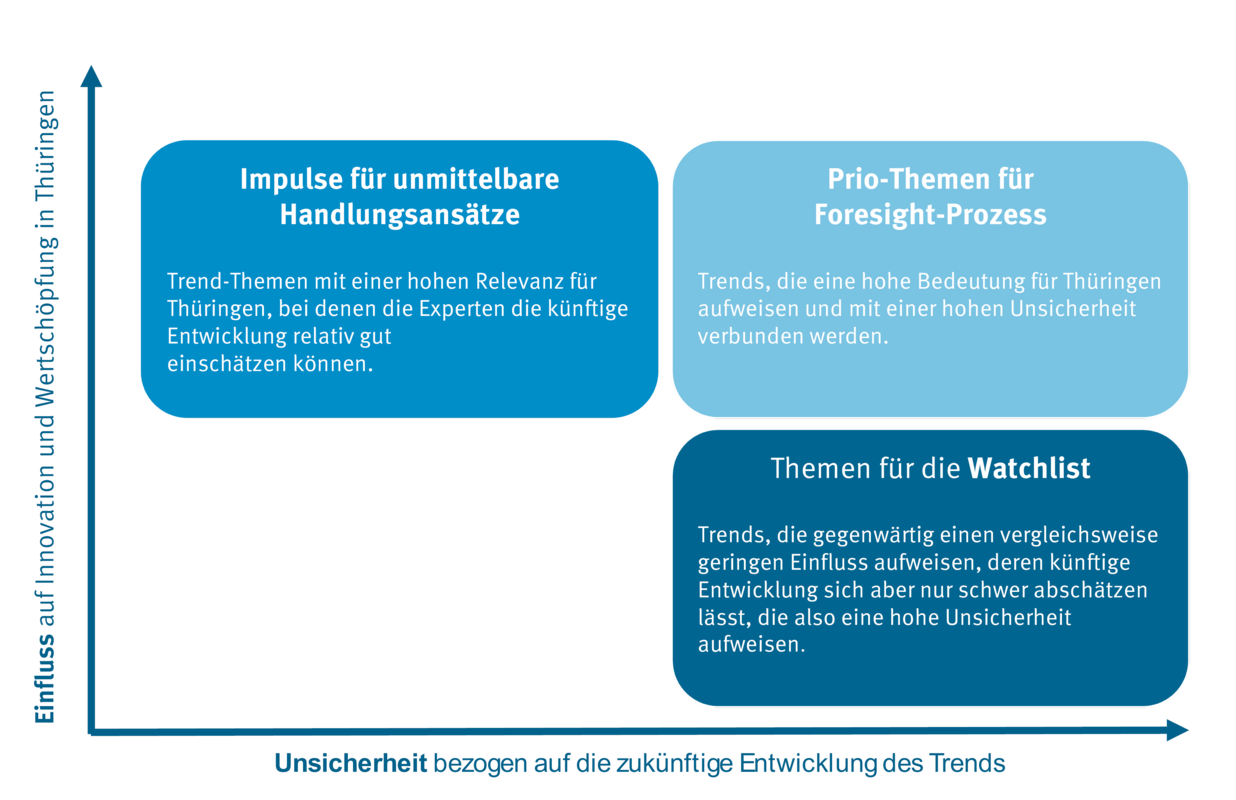
The experts assigned ten trends to the category of priority topics. In the next step, these priority topics were further qualified along the following categories in a technical discussion using the Future Canvas method:
- Opportunities: What positive possibilities does this trend open up for Thuringia? What innovation potential? What competitive advantages?
- Risks: What potential negative impacts/uncertainties are associated with the trend? What dangers could arise for certain industries, etc.?
- Affected stakeholders: Which actors are directly or indirectly affected by this trend? Which interests, needs, fears, etc. must be taken into account?
- Action approaches: How can actors in Thuringia influence through their actions whether potential opportunities are seized and risks are avoided? What strategic initiatives are necessary to respond appropriately to the trend trade fairs?
The ten Future Canvases created in this way were documented on Metaplan walls and presented in the plenary session. Finally, five of the priority topics were selected by dot voting, which were further analyzed in the anticipation workshops in the next phase of the foresight cycle.
3.3 Anticipation
The five focus trends identified in the trend workshop were elaborated for in-depth analysis and discussion within the anticipation phase in two half-day workshops. The aim was to structure potential medium- to long-term impacts of relevant changes and derive initial implications for the innovation and value creation location of Thuringia. Relevant experts from the Thuringian innovation system as well as the specialization field managers of Innovativ Thüringen were invited to ensure a broad range of expertise and practical knowledge.
The first Anticipation Workshop in January 2025 focused on analyzing future trends in health technologies and the health economy. The work was carried out in two groups: (1) AI-supported, robotic, and immersive technologies for personalized health with the potential to enable individualized and effective medical care through collaborative robotics and immersive applications, and (2) eHealth: AI for predicting, diagnosing, treating & preventing diseases with the aim of transforming healthcare through predictive analysis, precise diagnostics, and tailored prevention strategies.
The second anticipation workshop in February 2025 focused on key technologies of industrial value creation. Three groups worked on: (1) Context-sensitive sensor technology for adaptive systems in production, traffic, robotics, and energy supply, (2) Intelligent image processing for adaptive systems as a basis for autonomous, reactive, and learning-capable systems, and (3) Quantum-based & neuromorphic technologies for computing and sensor technology with disruptive potential for diverse fields of application.
For the workshops, two complementary foresight methods were specifically selected: (1) Futures Wheel and (2) the Visual Roadmap. The combination of both approaches links exploratory thinking under uncertainty with a structured derivation of concrete development paths.
Futures Wheel
The Futures Wheel is an established, developed by Glenn and Gordon a developed instrument of futures analysis, particularly suitable for complex and uncertain subject areas. It enables the systematic capture of the direct, indirect, and more distant impacts of a trend or event, without being constrained by linear thinking patterns. To support idea generation and stimulate thinking beyond linear patterns, assumptions are placed at the center of the Futures Wheel. In several rounds, conceivable consequences of the assumption are anticipated. First, immediate consequences (1st order) are identified, from which subsequent effects (2nd order) are derived, and finally systemic reactions (3rd order) are considered. This approach opens up a broad view of alternative chains of effects, without evaluating the probability of individual scenarios in advance. The method was chosen to make a variety of development possibilities visible for each trend topic, thereby creating a robust foundation for further analyses.

Visual Roadmap

The Visual Roadmap was developed by the iit. It is a strategic planning tool that presents future developments in a structured manner both temporally and thematically. It allows for a backward analysis from a defined target image (e.g., a business model in 2035) to determine which applications, technologies, framework conditions, and measures are required to achieve this goal. The method follows a clear four-level approach: (1) business models and intended effects, (2) necessary products and services, (3) technological prerequisites, and (4) socio-economic framework conditions and concrete measures. Through this vertical and horizontal structure, critical milestones, dependencies, and fields of action become clearly visible. Its selection is justified by the fact that it bridges visionary target scenarios and concrete action options, thus transferring the possibilities identified in the Futures Wheel into an implementation-oriented logic.
The combination of these two methods proved particularly suitable for the Thuringian Foresight process and the five focus trends selected here. On the one hand, the Futures Wheel allowed for the exploration of a broad possibility space under conditions of high technological dynamism and strategic uncertainty, while also making surprising or divergent development paths visible. On the other hand, the Visual Roadmap ensured that these exploratively identified paths could be transferred into a coherent future architecture – with clear time horizons, critical milestones, and designated fields of action. The methods thus complemented each other ideally: the strengths of the Futures Wheel in creative, divergent idea generation and the identification of systemic interactions were combined with the strengths of the Visual Roadmap in convergent structuring, prioritization, and operationalization. This made it possible not only to adequately map the complexity of the focus trends, but also to create direct connectivity to strategic decision-making and implementation processes in Thuringia.
In both workshops, the Futures Wheel was used in the morning to explore possible impact chains. In the afternoon, the Visual Roadmap was used to develop, based on a desirable target vision in the sense of a backcasting approach, which technologies, products and services, as well as which political, social and infrastructural framework conditions would need to be created by 2035 in order to realize these paths.
4. Results: Focus trends
The results of the first foresight cycle of Innovativ Thüringen and the Institute for Innovation and Technology (iit) at VDI/VDE Innovation + Technik GmbH are listed below and presented in detail. Chapter 4 provides an overview of the focus topics that have gone through the entire foresight process, including the anticipation workshop. Chapter 5 addresses other relevant future topics.
The following table provides an overview of all trend topics from Cycle I: 20 topics were addressed in the 2024 trend workshop. Of these, five were selected for the anticipation workshops.
4.1 Overview of Trend Topics
| Subject | Foresight process |
|---|---|
| AI-supported, robotic and immersive technologies for personalized health | Trend and Anticipation Workshop |
| AI-based eHealth Systems | Trend and Anticipation Workshop |
| Context-sensitive sensor technology | Trend and Anticipation Workshop |
| Intelligent image processing for adaptive systems | Trend and Anticipation Workshop |
| Quantum-based and neuromorphic technologies | Trend and Anticipation Workshop |
| Commercialization and technologization of space research | Trend workshop |
| New approaches to addressing environmental and health challenges | Trend workshop |
| Holistic approaches to integrated energy management | Trend workshop |
| Advanced materials and technologies for energy and information systems | Trend workshop |
| Smart cities with advances in infrastructure, AI, and cybersecurity | Trend workshop |
| Advanced autonomy and security strategies for unmanned aerial systems | Trend workshop |
| Sustainable and energy-efficient integrated heating/cooling systems | Trend workshop |
| AI, IoT, and modeling technologies for agriculture, environmental monitoring, and resource management | Trend workshop |
| Synergistic Digital Twins and IoT Systems | Trend workshop |
| Personalized Medicine: Diagnostics, Therapies & Health Strategies | Trend workshop |
| Multimodal AI applications and next-generation language processing | Trend workshop |
| Innovative therapy platforms & biomimetics for personalized medicine | Trend workshop |
| Biotechnological innovations and genomics to improve quality of life | Trend workshop |
| Internet of Vehicles (IoV), intelligent transportation systems and cybersecurity | Trend workshop |
| Multimodal Interactions and Embodiment in Hybrid Environments | Trend workshop |
4.2 AI-supported, robotic and immersive technologies for personalized health – for medicine that is more individual, accessible and effective

Personalized healthcare is on the threshold of a fundamental transformation. New technologies such as Artificial Intelligence (AI), robotics, and immersive technologies like Virtual Reality (VR) and Augmented Reality (AR) are opening up promising perspectives for making medical rehabilitation and care more individualized, efficient, and sustainable. At the heart of this trend is the combination of data-driven decision-making foundations with precision technologies and immersive forms of therapy. In this context, Thuringia can assume a pioneering role by linking its technological and scientific strengths with a patient-centered culture of innovation.
The application possibilities of these technologies are diverse: AI enables automated analysis of health data, allowing personalized therapy plans and nutritional and lifestyle counseling to be created. Robotics particularly supports rehabilitation, for example through robot-assisted physiotherapy or fine motor exercises for neurological conditions. Immersive technologies such as VR-based exergames not only increase patient motivation but also specifically improve users' balance, fitness, and pain management. Additionally, tele-rehabilitation and telepresence robotics open up new possibilities for location-independent care and, at the same time, more intensive patient support.
In addition to these technical opportunities, however, it is also necessary to address key challenges. The development and implementation of AI-supported, robotic, and immersive technologies requires a high degree of reliability, precision, and ongoing calibration in order to build trust in the technology and, consequently, a high level of acceptance among target groups (physicians and patients). A central prerequisite for this is comprehensive data protection and data security measures, as sensitive health data is processed in this application area.
For the trend of AI-supported, robotic, and immersive technologies for personalized health, the assumption in the qualitative analysis was that a private technology company will open a real-world laboratory for AI-based robotics in healthcare in Weimar in 2026, focusing on collaborative robots to support medical staff in surgeries and care tasks. A real-world laboratory is a test-space approach in which technological innovations are tested and further developed under real conditions together with practical stakeholders.
Results of the Futures Wheel
Within the framework of the Futures Wheel, work was carried out based on the assumption of a real-world laboratory in Weimar (see above). The aim was to systematically explore the possibility space of future developments based on this assumption. Three central development paths were identified, which show different potentials and challenges for the Thuringia location. Development paths identified within the framework of the Futures Wheel:
Results of the Visual Roadmap
As part of the qualitative further development of the findings gained in the "Futures Wheel" regarding the assumption of increased use of robotics and AI in Thuringia, the experts identified three business models with which economic success can likely be generated in 2035. The Visual Roadmap shows the connection between (i) applications and business models, (ii) required technologies, and (iii) societal framework conditions necessary to achieve a target point that is positive for the innovation location. The time horizon spans from 2025 to 2035.
Applications and Business Models
| Developed business models: | Products & Services: |
|---|---|
| Robot systems for care and health A pioneering business model has been identified in the field of intelligent robotic systems for home care. These include, among others, ultra-light, movement-supporting exoskeletons as well as new robotic systems that take over or supplement nursing tasks. These technologies address demographic change and the increasing demand for individual care in the home environment. |
|
| Training and further education centers Another business model could emerge through specialized information and training centers focusing on robotics and AI applications in the healthcare and logistics sectors. Clinics and other facilities can have their employees specifically trained in new technologies there, thereby promoting not only technology acceptance but also its efficient integration into existing processes. |
|
| Modular building block system for Robotics & AI Finally, an open modular system that integrates different components from the fields of robotics and artificial intelligence from various providers could be a possible scalable and adaptable business model. This would enable the precise configuration of technical systems depending on the area of application – be it in healthcare, logistics, or production – and opens up new market potential for Thuringian companies. |
|
Framework Conditions
For the successful development and market launch of these business models and the technologies, products, and services required for them, fundamental structural and systemic prerequisites are necessary. Political-strategic steering and coordination: Targeted development requires clear political steering and institutional coordination. State ministries, the LEG as the state's economic development agency, and specialized interest groups must jointly pursue a strategic vision. Through coordinated priority setting, resources can be pooled and targeted investments as well as funding measures can be established. Universities are key partners in research, education, and technology transfer. Education, skilled workers & qualification: Building a sustainable ecosystem for robotics and AI requires well-trained specialists. To this end, curricula at vocational schools, universities, and in professional further education must be modernized. Interdisciplinary skills in the areas of robotics, software development, nursing, and medical technology are particularly important. Research institutions should be thematically and infrastructurally aligned with robotic and AI applications. Legal & regulatory foundations: Reliable legal frameworks are essential for the marketability and safety of robotic systems. These include Europe-wide coordinated liability rules, regulatory standards for the use of sensitive technologies, and uniform certification processes. These requirements create trust among users, developers, and investors – and enable cross-border scaling. Ecosystem and network building: A high-performance innovation ecosystem thrives on functioning networks. Existing competence centers, such as in the field of AI and medical technology, must be networked, synergies specifically promoted, and technological openness institutionally anchored. Cluster and network organizations, such as OptoNet e.V. or medways e.V., play a central role here as bridge builders between research, industry, and application.
Technologies
The following technological prerequisites are required for the successful development and market launch of the anticipated business models and associated products and services:
| Technological prerequisite | Challenges |
|---|---|
| Sensor technology and body signal processing The goal is the highly precise acquisition of physiological states of the human body in everyday life, in care, or in the operating room. Various types of sensors (e.g., optical, bioelectrical, mechanical) are used to capture body signals and vital parameters in real time. | Reliability under real-world conditions (e.g., humidity, movement), miniaturization, energy-efficient data transmission, high data rate with limited bandwidth. |
| Motor systems and actuators for medical robotics Mechanical precision, adaptive motion control, and biomechanical compatibility are at the core of this key technology. It enables surgical assistance systems, exoskeletons, or robot-assisted care aids. | Dynamic adaptation to human movement patterns, material fatigue, certification of safety-critical drive systems. |
| Computing power & Embedded Hardware for Edge AI for AI-powered medical systems, powerful, miniaturized hardware is needed (e.g., specialized chips for image processing, sensor fusion, ML algorithms). This powerful hardware forms the backbone for the real-time capability of medical assistance systems. Specialized chips (e.g., ASICs, RISC-V) are crucial in this regard | Thermal efficiency, reliability in continuous operation, safety requirements for body-worn systems. |
| Methodology & software development for medical devices Medical software requires high standards in terms of reliability, traceability, and regulation. In addition to application development, generic methods are crucial, e.g., algorithmic validation, Explainable AI, semantic data annotation. The goal is therefore the development of particularly AI-based software with high reliability. | Approval procedures according to MDR/IVDR, model robustness under bias conditions, black-box behavior in deep learning. |
| AI-based robotic systems for medical operations Here, AI, sensor technology, motor skills, image processing and control technology combine to form autonomous or semi-autonomous robotic systems. AI algorithms analyze image and sensor data in real time and support decision-making. | Safety certification, liability issues, the boundary between assistance and autonomy, as well as approval issues for highly automated systems, ethical and legal differentiation of assistance and autonomy. |
| AR/VR/XR for Training and Interaction XR technologies expand interaction with medical systems. They are used in training clinical staff, patient education, and remote assistance, e.g., through virtual training, interactive assistance, or remote consultation. The focus is also on the further development of immersive, intuitively usable interfaces. | Ergonomics, acceptance and usability in medical contexts, real-time capability with high data complexity, integration with clinical routines. |
| Licensing & Patenting in the MedTech Sector To ensure economic exploitation, protective rights and legally secure licensing models are required. This is particularly important for AI methods, as they often lack a material component. | Speed and internationality of patent procedures, protection of non-material innovations (software, algorithms). |
Paths to the Future: AI-based Healthcare Robotics for More Innovation
Based on this possibility space, Thuringia could generate economic value by 2035 either through a modular building block system for robotics and AI products or through an internationally oriented training center in the field of AI-supported robotics. To achieve this goal, the following is of central importance: learning from the mistakes of the past and supporting existing companies in a needs-oriented manner in the sense of an active industrial policy, creating data spaces and interface infrastructure, and providing the institutes and companies with the necessary framework conditions.
The Visual Roadmap for the future of AI-supported, robotic, and immersive technologies for personalized health outlines Thuringia's path toward a highly networked healthcare and technology location. Robotic systems for medical care, nursing, and logistics, as well as immersive technologies such as AR, VR, or XR, which open up new possibilities for training, remote support, and decision assistance, play a central role. The further development of sensor interfaces, software integration, navigation technologies, and active systems forms the foundation for future-proof applications in real-time environments.
The application possibilities range from robotic assistance in the operating room and care, through simulation-based training formats, to novel service offerings in the healthcare sector. AI-based services, modular building block systems for medical robotics, and new business models combining technology and personalized care are becoming increasingly important. This also opens up new roles for potential insurance providers who could cover AI-supported risks. The roadmap makes it clear that suitable regulatory, technological, and organizational framework conditions are required for the sustainable introduction of these technologies. Standards must be further developed, continuing education systems adapted, and digital infrastructures expanded. It is therefore sensible to check, through a targeted query in the Innovativ Thüringen network, which actors from science and industry are already involved in relevant standardization bodies at the national and European level. It is known from other federal states that companies and research institutions often lack the necessary resources to contribute their expertise strongly to standardization and normalization processes for the benefit of the local innovation landscape. Therefore, it could be useful to specifically identify relevant Thuringian stakeholders who receive funding from the state government to provide personnel resources here. To achieve a high coherence of the activities of Thuringian actors and to balance particular interests, it may also be useful to establish a permanent expert dialogue on the topic of “Standards made in Thuringia”, in which the actors from the Free State involved in standardization bodies continuously exchange ideas with the state government and discuss common objectives. Cooperation between ministries, universities, economic development agencies such as LEG, and research platforms such as OptoNet e.V. or medways e.V. is seen as a central lever for implementing common goals. At the same time, transparent processes for citizen participation and social acceptance are needed.
Skilled workers are a critical success factor. New qualification profiles are needed, particularly at the interfaces between technology, nursing, software development, and medicine. Training centers, real-world laboratories, and platforms for education and further training must therefore be systematically considered and institutionally anchored. The question of local training of robots, digital support in everyday life, and inclusion of different user groups is also becoming increasingly relevant. With regard to a forward-looking change in job profiles, it could be useful to use a forward-looking analysis of future competency requirements at the interface described above to specifically estimate which professional profiles could develop over the next five to ten years. This would make it easier for the state government and the further education landscape in the Free State to drive forward necessary curricular, didactic, and capacity-related changes at an early stage.
4.3 AI-based eHealth systems – with the potential to fundamentally transform medical care through predictive analysis, precise diagnostics, and individualized prevention

The use of AI in eHealth systems marks a profound transformation in healthcare. Through the intelligent analysis of patient data, diseases can be detected earlier, diagnoses supported, and individualized treatment plans developed. Preventive measures can be initiated more specifically, while access to medical care is improved and medical staff are relieved by automated routine tasks. These technologies not only create efficiency gains but also open up new perspectives for personalized, more precise, and comprehensive care. Concrete examples of AI-based eHealth systems range from AI-supported analysis of medical imaging data (e.g., X-rays or MRI scans) to digital health applications (DiGA) that assist patients in managing chronic diseases, and the expansion of telemedicine consultations. Electronic patient records and health cards are also essential components of a digitally networked, AI-supported healthcare system.
These developments extend throughout the entire value chain of the healthcare system. Both inpatient facilities and outpatient practices and home care services, as well as municipalities and their health departments, could be directly affected as users of these technologies. Key players in the further development of these technologies are, on the one hand, companies in medical technology, software development, and data analysis, and on the other hand, research institutions, universities, and further education institutions that ensure the necessary knowledge transfer and the training of future specialists.
In Thuringia in particular, these technologies open up opportunities that go beyond purely technological aspects. It is conceivable that regional disparities in care could be balanced out, that medical care in rural areas could be better connected, and that new business models for companies could be developed at the same time. Companies and research institutions in the Free State already possess key competencies in medical informatics, AI development, and healthcare research.
For the qualitative analysis of the trend, the assumption was made that by the end of 2035, 60 percent of hospitals and medical practices in Thuringia will use AI-based diagnostic systems. In January 2025, as part of an expert workshop, possible central development paths of the trend were identified using the Futures Wheel, and a future path was developed using the Visual Roadmap, which describes how a positive target point for the innovation location Thuringia can be achieved in 2035.
Results of the Futures Wheel
As part of the Futures Wheel, the following assumption was used: “By the end of 2035, 60 percent of hospitals and medical practices in Thuringia will use AI-based diagnostic systems.” The goal was to systematically explore the possibility space of future developments based on this assumption. Three central development paths were identified, highlighting different potentials and challenges for the Thuringia location. As a result, three central development paths were identified:
Results of the Visual Roadmap
As part of the qualitative further development of the insights gained from the Futures Wheel regarding the assumption that by the end of 2035, 60 percent of hospitals and medical practices in Thuringia will use AI-based diagnostic systems, the experts identified three business models that are expected to generate economic success in 2035. The Visual Roadmap shows the connection between (i) applications and business models, (ii) required technologies, and (iii) social framework conditions necessary to achieve a positive target point for the innovation location. The time horizon spans from 2025 to 2035.
Applications and Business Models
| Developed business models: | Products & Services: |
|---|---|
| Data Administrator/Data Trustee A promising business model is emerging in the area of data trusteeship in healthcare. Data trustees take on a mediating role between data-holding institutions (e.g., clinics, laboratories), application-oriented actors (such as startups or care platforms), and regulatory bodies. They build trust through legally secure data management, consent management, and data protection-compliant access structures. |
|
| AI-based Evaluation of Medical Image Data Another business model lies in the development and application of AI systems for medical image recognition. This involves not only diagnostic support, but also pattern recognition, early warning systems, and structured documentation. The business opportunity lies in combining highly specialized image analysis methods (e.g., for radiological, dermatological, or histological data) with adaptive AI algorithms that can adjust to new data. For Thuringian companies and research institutions, this offers potential in product development, services (e.g., as certified software providers), and clinical partnerships with imaging departments. |
|
| Integrated Health Models – Medicine meets ICT In the long term, a scalable business model emerges through the integration of medical care with information and communication technology (ICT). Here, healthcare services, therapy suggestions, patient data, and care chains are intelligently networked. This model aims for continuous, personalized, and resource-efficient healthcare – both in inpatient and outpatient contexts. Thuringian companies that combine technical infrastructure, medical expertise, and digital service logic can position themselves as system integrators or platform providers in this field. |
|
| Therapy-oriented AI systems and decision support This business model is based on digital assistance systems for personalized therapy selection, e.g., in oncology or for rare diseases. Providers develop algorithmic suggestion systems that support physicians with current therapy recommendations. |
|
| Regional care partners and health infrastructure providers A business model aimed at stable, comprehensive medical care with a regional focus. The goal is to establish network structures, care solutions, and innovation centers in rural areas – supported by digital systems. |
|
Framework Conditions
The introduction of AI-supported health applications takes place in several stages. Social, regulatory, and institutional conditions evolve alongside them. Over time, key prerequisites can be identified that must be created step by step. Securing acceptance among key stakeholders: Already in the early phase, it is crucial that central actors in the healthcare system recognize the potential of new technologies and actively contribute to their development and testing. Acceptance among lead providers, i.e., large hospitals, research companies, or health insurance funds, acts as a catalyst for market entry, connectivity, and investment security. Early participation also ensures the relevance and practical applicability of the emerging solutions. Enabling data cooperation: Access to high-quality clinical data remains one of the main bottlenecks for the development of learning systems. Therefore, the willingness to share data, especially by hospitals, laboratories, and research partners, is an important foundation. It presupposes trust in governance structures: data protection, purpose limitation, and security must be reliably regulated so that innovation and accountability go hand in hand. Ensuring the quality of dynamic systems: With the increasing use of AI in clinical processes, assessment standards must also be further developed. Classic testing criteria fall short when systems are based on changing data or learn continuously. Accordingly, new quality requirements must be defined that integrate both technical robustness and ethical and clinical-practical aspects without blocking innovation. Designing health insurance approval as a systemic bridge: Innovations only unfold their impact when they reach standard care. For this, health insurance approval is a structural key moment: it decides on availability, scaling, and refinancing. Assessment and reimbursement procedures must therefore be adapted to the characteristics of digital medicine – for example, regarding algorithm dynamics, traceability, and verifiability. Methodically anchoring diversity: Reliable AI in medicine must not be based on average data. Gender-equitable sampling and the representation of children and adolescents are therefore not a marginal issue, but a methodological claim to equal opportunities and clinical precision. Studies, training, and validation processes must systematically consider diversity to avoid biases and ensure adequate diagnoses and therapy recommendations. Socially stabilizing technology acceptance: Ultimately, the widespread introduction of AI-based systems depends on their high acceptance in everyday life. This does not arise from technology alone, but through understandable communication, explainable decision-making paths, and a tangible improvement in care. A participatory development culture, transparent usage chains, and ethical reflection are decisive factors for trust and openness to use.
Technologies
The following technological prerequisites are required for the successful development and market launch of the anticipated business models and associated products and services:
| Technological prerequisite | Challenges |
|---|---|
| Biomarker Integration and Screening Technologies For the early detection of individual health risks and for more precise diagnostics, integrated, multimodal methods for the detection and combination of biological markers are required. The integration of various biomarkers enables a deeper interpretation of molecular and imaging diagnostics, especially in complex disease patterns. Screening as a population-based early detection also benefits from automated analysis procedures and predictive models. Due to the requirement for data sharing and data integration, the role of data trustees would gain relevance. | Standardization of sampling and evaluation processes, validation of predictive markers, scalability for broad application. |
| Data technologies for secure and adaptive information processing The increasing networking in the healthcare system requires technological solutions for secure, privacy-compliant, and adaptive information sharing. Federated Learning as a technological solution for data sharing enables the training of AI models without the need to centralize sensitive patient data. In addition, Differential Privacy is a key technology for protecting personal information that remains statistically untraceable even with repeated use. | Computational cost of decentralized learning methods, securing distributed infrastructures, technical complexity when deploying in hospital systems. |
| Multimodal Imaging and Interpretable AI For precise and reliable medical diagnostics, multimodal imaging is central – i.e., the combination of different imaging techniques (e.g., MRI, CT, ultrasound) and diagnostic data sources. For clinical acceptance of such systems, explainability solutions are essential, making decision-making processes comprehensible – especially in AI-supported analyses. They form the basis for trust and medical reassurance. | Data alignment of different sources, real-time processing of large data volumes, integration into clinical workflows. |
| Biotechnological therapies and test systems With progress in regenerative medicine, stem cell-based therapies are coming into focus – both in personalized oncology and in tissue and organ regeneration. At the same time, the demand for human-representative tests is increasing, which better reflect physiological reality than classical animal models. Such systems use, for example, organ-on-a-chip technology or AI-supported cell culture analyses. | Standardization of biological materials, ethical approval, long-term courses. |
| Technology acceptance through user-centered design To sustainably anchor technological systems in healthcare, their usability and everyday practicality are crucial. Usability and UX design ensure that medical staff as well as patients can use new digital applications effectively and without barriers. They are therefore more than just a "surface“ – but an integral part of medical quality. | Interdisciplinary development processes, variability of medical usage scenarios, acceptance of heterogeneous user groups. |
Paths to the Future: Rethinking Healthcare
Based on this possibility space, Thuringia could become the leading provider of personalized medicine by 2035. To achieve this goal, it is of central importance to create suitable framework conditions. These include reliable data backup systems, data infrastructure standardization, certifications, as well as awareness and acceptance programs for the population. The Visual Roadmap for eHealth in Thuringia describes an ambitious vision of a digitally supported, personalized, and networked healthcare system. A central role is played by the intelligent use of AI technologies, for example for image analysis, therapy recommendation systems, or multimodal diagnostic solutions. Technological foundations such as data management systems, software development for clinical application, test platforms, or the integration of various biomarkers form the basis of an increasingly data-driven healthcare system.
A central goal is the establishment of new provider structures that combine genomics, AI, and medical technology, supported by trustworthy data infrastructures. This also creates new roles in the system, e.g., for data trustees, curating institutions, or companies that analyze and validate clinical data. These actors operate in close coordination with physicians, associations of statutory health insurance physicians, clinics, and patients. In the future, test development, certification, and application will be organized via platforms that bundle both medical expertise and digital system competence. Given the complexity and high ambition of the described potential future development, it should be examined whether the state government or Innovativ Thüringen specifically initiates a cross-sectoral dialogue process that includes the previously described stakeholders and in which necessary measures are discussed jointly on how this development can be incentivized. This is not only about what politics can do, but about identifying what contributions each stakeholder can and will make to this overall vision. The dialogue process could be supported by a preliminary feasibility study for the establishment of a corresponding provider structure and trustworthy data infrastructure in the Free State.
The focus is on people, both as users of new systems and as part of an integrative care model. Aspects such as explainable AI, data protection, gender-sensitive sampling, and user-friendly design are increasingly being incorporated into development. At the same time, new requirements for education and training are emerging. Future specialists must be able to combine both technological and medical skills. Appropriate training formats and targeted continuing education offerings in machine learning and health technologies are becoming necessary.
Politically and structurally, a coordinated approach is needed, ranging from cross-departmental funding strategies and special translation programs to the early involvement of health insurance companies in approval and market access issues. The development of digital care structures in rural areas, the creation of trustworthy data platforms, and the positioning of Thuringia as a model region for data-driven, personalized medicine form the central pillars of this vision. It should be examined whether the establishment of a Trusted Data Center can be the decisive foundation for building a model region. The Trusted Data Center, based on its function for the healthcare sector, could also be conceived as a cross-industry and scalable solution. The center should serve not only as pure infrastructure for providing computing power and storage capacities, but as an institutional platform that holds specific know-how for merging and utilizing sensitive health data. The implementation of advanced anonymization technologies is essential to ensure the secure and data protection-compliant handling of personal information. This center could not only act as a central resource for secure data processing, but also as a coordinating body for a federal AI architecture in healthcare. By promoting the interoperability of data systems and serving as a platform for the exchange and analysis of health data, it could play a key role in the development of data-driven, personalized medicine and at the same time establish Thuringia as a pioneering region for trustworthy health data infrastructures.
eHealth is not a niche topic, but a strategic field of action for medical quality, economic development, and social participation. Thuringia can take on a pioneering role here if it succeeds in bringing together technology, trust, competence development, and financing.
4.4 Context-sensitive sensor technology – as a key for adaptive systems in industry, mobility and everyday life, which intelligently capture and use environmental information

Context-sensitive sensor technology encompasses sensor systems that capture and interpret relevant information from their environment. Various sensor data, such as optical or acoustic data, are processed and enhanced through the use of AI-based systems. In this way, context-dependent environmental data can be analyzed in real time and adaptive responses enabled. A combination of different sensors and their signals leads to a profound environmental analysis with a high information content. Previous application areas range from autonomous navigation of drones or robot swarms, environmental monitoring and traffic control, to smart homes and mechanical and plant engineering. Context-sensitive applications still in research and development exhibit significantly higher complexity. Challenges lie in the integration and real-time processing of large, heterogeneous data volumes, the energy requirements of mobile applications, the performance of specified algorithms, and ensuring data protection and data security. Furthermore, the current lack of standardization particularly hinders the interoperability of such systems.
A central field of application that may gain importance in the future is the further development of context-sensitive smart city approaches. Here, intelligent sensor systems can help make urban spaces more efficient, safer, and more sustainable – for example, through adaptive traffic control, intelligent energy distribution, or the early detection of environmental pollution. The trend is clearly moving towards ever greater networking and integration of sensor data, which, through AI-based analysis, enables new forms of urban planning, mobility, and public services. In the long term, context-sensitive sensor technology thus not only opens up new business models but can also make a significant contribution to the quality of life and resilience of urban and rural areas.
For the qualitative analysis of the trend, the assumption was made that by the end of 2035, Thuringia will be a leader in the development and production of context-sensitive sensor technology for production, traffic, robotics, and energy supply. In February 2025, as part of an expert workshop, possible central development paths of the trend were identified using the Futures Wheel, and a future path was developed using the Visual Roadmap, describing how a positive target point for the innovation location Thuringia can be achieved in 2035.
Results of the Futures Wheel
As part of the Futures Wheel, the following assumption was used: “In 2035, Thuringia is a leader in the development and production of context-sensitive sensor technology for manufacturing, transportation, robotics, and energy supply.” The goal was to systematically explore the possibility space of future developments based on this assumption. Four central development paths were identified, which highlight different potentials and challenges for the Thuringia region.
Results of the Visual Roadmap
As part of the qualitative evaluation of the visual roadmap developed in the anticipation workshop, four business model approaches were identified that could develop economic potential based on technological developments and specific fields of application in the Free State. The visual roadmap shows the connection between (i) applications and business models, (ii) required technologies, and (iii) societal framework conditions necessary to achieve a positive target point for the innovation location. The time horizon spans from 2025 to 2035.
Applications and Business Models
| Developed business models: | Products & Services: |
|---|---|
| AVT as a product A viable business model emerges from the industrial scaling of assembly and interconnection technology (AVT) for sensor systems. Through targeted further development in terms of cost efficiency, real-time capability, and miniaturization, AVT can advance to become an independent product line that can be used in a wide range of application fields – for example, in environmental monitoring, production automation, or mobile sensor systems. For Thuringian providers, the opportunity arises to position themselves as system suppliers for modularly designed AVT components. In particular, OEM-near applications and integration into existing machine infrastructures promise attractive sales markets. The connection with regional software development for AVT-specific interfaces additionally strengthens vertical value creation. |
|
| Sensor-as-a-Service A particularly dynamic business model is unfolding in the area of usage-based sensor services. Modularly configurable multi-sensor systems make it possible to flexibly provide sensor functions as a service – e.g., for temporary deployments in forestry, air quality measurement, or traffic monitoring. Customers gain access to sensor technology, data collection, and preprocessing without having to maintain proprietary hardware themselves. For Thuringian stakeholders, this model offers the potential to establish themselves as full-service providers of sensor-on-demand – supplemented by digital interfaces, GDPR-compliant data provision, and accompanying analysis services. |
|
| Forecast and assistance systems From the intelligent evaluation of multimodal sensor data, scalable business models emerge in the field of predictive control and decision support. Sensor-based assistance systems enable, for example, early traffic jam forecasts, monitoring of critical infrastructures, or predictive maintenance processes. These systems combine sensor data fusion, real-time communication, and AI-supported interpretation models. For Thuringia, this results in application areas along the entire urban infrastructure, particularly in mobility, traffic management, or disaster protection. Local providers can act here as integrators between sensor technology, software, and practical application. |
|
| Sustainable Sensor Solutions A pioneering business model is emerging in the field of environmentally compatible sensor systems for temporary outdoor applications. Biodegradable sensors, such as those being developed at the TITK (Thuringian Institute for Textile and Plastics Research), are opening up new application perspectives for environmental and agricultural sectors – for example in soil moisture monitoring, forest fire prevention, or biodiversity-related monitoring. This model simultaneously addresses increasing demands for sustainability and material circularity. For Thuringian companies, this creates the opportunity to develop new niche markets with innovative materials and sensor designs – both in public contracts and in the high-growth environmental technology market. |
|
Framework Conditions
Establishing context-aware sensor technology as a forward-looking technology area requires more than technological innovation. A coordinated interplay of education, market knowledge, regulation, and ecosystem development is crucial. Along the development path, five central prerequisites can be identified that must be strategically built up and sustainably secured:
Systematically initiate skilled workforce development: The establishment of a specialized degree program in Sensor Engineering marks a first structural step towards long-term competence assurance. In addition, early-stage educational offerings are needed that anchor technological topics already in schools and career orientation. Interdisciplinary qualification programs at universities and further education institutions are necessary to meet the growing demand for specialists in the development, application, and maintenance of sensor-based systems. Ensure demand-oriented development through market proximity: For the economic scaling of sensor-based solutions, it is essential to closely link technological developments to real needs. Systematic market analyses and consumer insights provide the basis for market-driven innovations and prioritized development paths. Especially in domain-specific fields of application, user needs must be identified early and fed back into technology development. Consider cybersecurity and regulatory requirements early on: With the networking of sensitive sensor systems, the requirements for security and regulation also increase. The consistent implementation of existing regulations, particularly the European NIS-2 Directive on network and information security, is a central prerequisite for trust, market access, and investment willingness. Sensor solutions must be designed already in the development phase taking into account current security standards in order to minimize later adaptation costs and regulatory hurdles. Cybersecurity thus becomes an integral part of technological product development. Promote interoperability as a basic requirement: For sensor systems to be scalable and flexibly deployable, open, standardized interfaces are required. The targeted use of open-source technologies such as OPC UA creates the necessary technical basis for cross-system communication, both in industrial and public infrastructures. Consistent interface acceptance avoids technological fragmentation. This creates seamless, modularly connectable systems that can also hold their own in heterogeneous data environments. Strengthen innovation ecosystems spatially and structurally: For the sustainable anchoring of sensor-based value creation, a targeted development of regional ecosystems is necessary. This includes active settlement strategies for sensor and software companies, ideally in spatial proximity to universities, data centers, and technology transfer institutions.
Technologies
The following technological prerequisites are required for the successful development and market launch of the anticipated business models and associated products and services:
| Technological prerequisite | Challenges |
|---|---|
| Sensor diversity and multi-sensor systems A central element of technological innovation lies in the combination of a wide variety of sensor principles: acoustic, optical, radar, and multiphysical sensors, together with intelligent software for data fusion, form the basis for adaptive, context-sensitive sensor systems. These systems enable precise environmental perception in mobility, infrastructure monitoring, and Industry 4.0. | Different data frequencies and qualities, complex synchronization of sensors, robustness under varying environmental conditions. |
| Assembly and Interconnection Technology (AVT) AVT forms a technological core for the realization of highly integrated sensor systems. It enables the precise connection of electronic and non-electronic components – a decisive step towards miniaturization and performance enhancement of sensor platforms. AVT is not only regarded as an enabler, but also as a potential product with its own market value. | High initial development costs, real-time capability, thermal and mechanical stability, quality assurance in series production. |
| System integration and interface capability For the efficient integration of context-sensitive sensor solutions, the development of cross-application interfaces is crucial. The heterogeneity of sensory data sources requires technological solutions for harmonization and transferability. Openness, modularity and standardization are essential principles. | Cross-manufacturer interoperability, compatibility with legacy systems, real-time data availability. |
Paths to the future: Context-sensitive sensor technology as a key technology
Based on this opportunity space, Thuringia could earn money with Sensor-as-a-Service in various sectors by 2035. To achieve this goal, it is of central importance to create data spaces and interface infrastructure and to provide the institutes and companies with the necessary framework conditions. A central prerequisite for this is massive engagement with international standardization bodies.
The Visual Roadmap for context-sensitive sensor technology describes how Thuringia can systematically expand its role as a center of competence for adaptive, scalable sensor solutions by 2035 through targeted technology and infrastructure development. The starting point is the further development and combination of highly specialized sensors, such as acoustic, radar, or optical sensors, which are integrated into multi-sensor systems. These are supplemented by AI-based software solutions that analyze complex environmental data, movement patterns, or system states in real time. Assembly and connection technology (AVT) plays a special role here. This involves the recording and evaluation of parameters such as speed, realism, and costs in order to validate the performance of intelligent sensor systems in a practical manner. To support this development, the state government should examine the extent to which real-world laboratories for autonomous mobility can be established in Thuringia, serving as test environments for context-sensitive sensor technology in traffic, logistics, and robotics. These laboratories should not only function as technological testing spaces but also as platforms for the development and implementation of standards and regulatory frameworks. Furthermore, Thuringia could be positioned as an international partner for autonomous mobility by pursuing a strategic partnership with global players in the field of mobility and technology.
These systems unfold their potential in a wide range of application fields. These include real-time forecasts in traffic and agriculture, monitoring of critical infrastructures, as well as assistance systems that gradually lead to full automation. In the field of AVT, new solutions are also being developed for scalable multisensor platforms that can be used across applications. Sensor technology thus becomes the central foundation for sustainable and adaptive systems, for example in traffic management, digital forestry, or environmental analyses. Ecologically oriented sensor solutions are also gaining importance, such as biodegradable particle sensors or self-scaling monitoring systems.
Such an innovation system requires a powerful data and cloud infrastructure. This must be both data-sovereign and accessible. The roadmap refers to projects such as the Thüringen Cloud, which is intended to enable secure, GDPR-compliant processing of large volumes of data. This is also linked to the need for open interface standards that allow flexible integration of various sensor principles. In addition to the technical implementation, social prerequisites must also be created, particularly in matters of data sovereignty, transparency of automated decisions, and the establishment of trustworthy systems.
At the same time, a systematic development of professional and training expertise is required. Degree programs such as Sensor Engineering, part-time continuing education formats, and targeted talent promotion are intended to help secure both skilled workers and interdisciplinary project teams in the long term. At the same time, greater visibility of sensor-related job profiles is necessary, supplemented by modern communication formats, in order to also promote social acceptance of context-sensitive sensor technology.
In the long term, Thuringia aims for an integrated sensor ecosystem that balances ecological sustainability, economic scalability, and social acceptance. AVT plays a key role as a bridge between technological progress and real-world application. The roadmap makes it clear that context-sensitive sensor technology goes far beyond a single technology. It forms the basis for new business models, data-based services, and future-oriented location development.
4.5 Intelligent Image Processing – as a foundation for autonomous, reactive, and learning-capable systems in dynamic environments

Intelligent image processing uses advanced methods of artificial intelligence (AI) and machine learning to analyze, interpret, and respond to visual data in real time. It is no longer just about the pure capture and storage of image information, but about the development of learning-capable systems that can adapt to changing environments and continuously learn from new data. These systems combine high-resolution image sensors with powerful AI algorithms and are capable of performing complex tasks such as facial recognition, motion analysis, and object detection.
This technology is used in the automotive industry, where intelligent image processing systems enable autonomous navigation by precisely recognizing obstacles, pedestrians, or traffic signs. In industrial manufacturing, intelligent image processing increases quality assurance through automated error detection on production lines. In medicine, intelligent image analysis supports the early detection of diseases, for example, through the automated evaluation of MRI or X-ray images. Furthermore, this technology is also gaining increasing importance in security and surveillance technology, for instance, for biometric access controls or behavioral analysis.
Challenges primarily arise in the integration and processing of large volumes of data, in ensuring the real-time capability of the systems, and in adapting to different lighting conditions and complex environments. In addition, there are legal issues, particularly regarding the use of sensitive personal data (e.g., facial recognition in public spaces). The trend toward intelligent image processing makes it clear that not only technical but also social and legal questions are decisive for the acceptance and sustainable use of this key technology.
For the qualitative analysis of the trend, the assumption was made that by the end of the 2020s, Thuringia will have become a pioneer in the field of intelligent image processing in the areas of AI-supported manufacturing, robotics, and autonomous mobility. In February 2025, as part of an expert workshop, possible central development paths of the trend were identified using the Futures Wheel, and a future path was developed using the Visual Roadmap, describing how a positive target point for the innovation location of Thuringia can be achieved by 2035.
Results of the Futures Wheel
As part of the Futures Wheel, the following assumption was used: “By the end of the 2020s, Thuringia has become a pioneer in the field of intelligent image processing in the areas of AI-supported manufacturing, robotics and autonomous mobility.” The aim was to systematically explore the possibility space of future developments based on this assumption. Two central development paths were identified, which show different potentials and challenges for the Thuringia location.
Results of the Visual Roadmap
As part of the qualitative further development of the insights gained from the Futures Wheel regarding the assumption of a pioneering role for Thuringia in the field of intelligent image processing, the experts identified five business models that are expected to generate economic success by 2035. The Visual Roadmap shows the relationship between (i) applications and business models, (ii) required technologies, and (iii) social framework conditions necessary to achieve a positive target point for the innovation location. The time horizon spans from 2025 to 2035.
Applications and Business Models
| Developed business models: | Products & Services: |
|---|---|
| Data Center & Computing Center A forward-looking business model lies in the construction and operation of powerful, regionally anchored data centers. These provide the necessary digital infrastructure for data-intensive applications, such as AI-supported map generation, training of autonomous systems, or the processing of multimodal sensor data in mobility, healthcare, and production. Data centers enable sovereign, GDPR-compliant data processing while simultaneously securing local value creation. For Thuringia, this presents the strategic opportunity to strengthen digital sovereignty and provide its own data networks as basic infrastructure for future business models. |
|
| Platform Provider/Cloud Provider A scalable business model arises from the role as a provider of cloud-based platform infrastructures for data-driven services. Platform providers coordinate the integration of sensor data, control systems, and AI analytics, thus creating the technical foundation for the cross-sector use of smart systems. The platforms act as an intermediary structure between data sources and users, offer standardized interfaces, and enable modular expansion through software services. For Thuringian companies, this offers the opportunity to occupy central interfaces in the emerging data ecosystem. |
|
| Data provider for AI-supported manufacturing processes A business potential lies in the specialized provision of industrially usable data sets to improve AI-supported manufacturing processes. Data providers collect, structure, and maintain production-relevant data with high quality and regulatory security. Their offerings target companies that want to use learning systems, digital twins, or adaptive production planning. These providers play a key role in data-driven manufacturing ecosystems and make it possible to establish data-based value creation even in small and medium-sized enterprises. |
|
| Complete solution provider in the field of autonomous mobility A comprehensive business model arises from the ability to provide complete system solutions in the field of autonomous mobility. Full-service providers combine sensor technology, software, vehicle engineering, and cloud infrastructure into operational mobility solutions – for example, for rural regions, logistics services, or municipal traffic control. Through integration and standardization, they create marketable offerings that make complex technologies accessible to users. Thuringian providers could thus distinguish themselves as system integrators in a growing mobility segment. |
|
| Thuringia as a full-service provider for adaptive manufacturing technologies A strategic business model emerges from positioning Thuringia as a location for adaptive manufacturing technologies with high modularity. The focus is on scalable sensor systems, intelligent AVT processes, and flexible software solutions that allow dynamic adaptation to changing manufacturing conditions. The combination of hardware intelligence, interface standardization, and AI-supported control opens access to innovative automation solutions, especially for small and medium-sized enterprises. Thuringia could become visible here as a complete system provider along the digital manufacturing chain. |
|
Framework Conditions
For the successful development and market launch of the anticipated business models as well as the associated technologies, products and services, fundamental structural and strategic prerequisites are required:
Infrastructure development and visibility: To strengthen regional innovation capacity, targeted investments in high-performance infrastructure are required. The construction of a data center in Thuringia is identified as a critical prerequisite for data-intensive applications. Complementary awareness-raising measures are necessary to increase the visibility and social acceptance of such a data center. Access to computing power is thus established as a system-relevant component for data-driven business models. Technology transfer and university networking: The transfer of technology from universities to economic application fields plays a central role in the market penetration of new sensor solutions. The ZLV (Central State Distribution Point) of the universities serves as an institutional interface for this purpose. Transfer and start-up centers are to be specifically expanded to promote spin-offs, cooperation with SMEs, and early product development. Innovation culture and regulatory experimentation: Testing sensor-based technologies and their system integration requires flexible test environments. The establishment of real-world laboratories, enabled by appropriate experimentation clauses, creates scope for technical testing, participatory development processes, and regulatory approximation. Thuringia can take on a pioneering role here through model pilot projects and simultaneously co-develop standards. Cluster-oriented value creation: The formation and further development of value-creating clusters is understood as a key to sustainable regional development. Through the targeted establishment of regional networks between companies, research institutions, and start-up actors, robust innovation ecosystems emerge that ensure long-term competitiveness and help open up new markets.
Technologies
The following technological prerequisites are required for the successful development and market launch of the anticipated business models and associated products and services:
| Technological prerequisite | Challenges |
|---|---|
| Multispectral sensor technology and multimodal imaging A central technology field lies in the development of multispectral sensors (VIS–IR) as well as multimodal imaging systems that combine data from different sources – optical, thermal, or radar-based. In conjunction with intelligent lighting and multimodal data analysis, systems with high precision and a broad range of applications are created. | Calibration of heterogeneous sensor sources, real-time processing of large data volumes, synchronization of visual and non-visual information channels. |
| Edge computing and decentralized computing architectures For data-intensive applications – such as in autonomous systems or real-time monitoring – powerful high-performance chips at the network periphery are required. They enable local data processing with low latency. | Energy efficiency under full load, thermal stability, integration into miniature hardware. |
| AI-supported control and navigation The combination of AI tools with precise navigation (sensor data fusion) forms the backbone of adaptive systems in mobility, production, and logistics. Expert systems that access sensor data make decisions in complex, dynamic environments. | Interpretability of AI decisions, data quality from heterogeneous sources, latency times in decision-making. |
| Communication technologies and connectivity For the secure and low-latency transmission of sensory and machine data, a robust connectivity infrastructure is required. Scalable communication solutions are central, especially for mobility applications or distributed sensor systems. | Network stability under high load, protection against third-party access, interoperability between system components. |
| Data center and digital infrastructure for computing power Compute-intensive sensor systems require locally anchored data centers with high storage capacity and high-performance infrastructure. They serve not only for data processing but also as a security anchor for sensitive information. | Sustainable energy use, high availability, data protection compliance. |
Paths to the Future: From Innovation Space to Full-Service Provider of Adaptive Technologies
Based on this possibility space, Thuringia could become the land of digital Hidden Champions 2.0 by 2035 and position itself as a full-service provider for adaptive manufacturing technology, for example with adaptive robots for various fields of application. To achieve this goal, it is of central importance to provide research spaces and support new innovation cycles. The starting point is the consistent further development of image processing technologies: From multispectral sensor systems to highly integrated edge chips to AI-based imaging, navigation, and control systems, new basic technologies are emerging that are transferred into a wide range of applications. Particularly noteworthy here is sensor-based real-time analysis in mobility, logistics, and maintenance contexts, as well as the development of learning systems for map generation and condition monitoring.
These technologies culminate in concrete products and services: for example, in the form of sensor/software kits for mobility applications, training systems for AI use, or comprehensive Mobility-as-a-Service solutions. Applications range from autonomous vehicles to agricultural and medical robotics, all the way to digital twins for urban infrastructure. Data centers and data-intensive platforms form the backbone of these innovations, both in research and in operational scaling. To realize this potential, the previously recommended Trusted Data Center should function not only as central infrastructure in the healthcare sector, but also as a critical component for implementing Thuringia's vision as a “Land of Digital Hidden Champions 2.0“. This center could, in particular, play a key role in the development of adaptive manufacturing technologies through its expertise in the secure handling of sensitive and highly complex data. The platform should process data from various industries, such as the mobility and logistics sectors, and make it available for the further development of AI-supported image processing, navigation, and control systems. The Data Center could act as an interdisciplinary hub, enabling the secure exchange and use of data from different sectors – from autonomous vehicle technology and digital agriculture to robot-assisted maintenance and servicing processes. Through the use of advanced anonymization technologies and data protection-compliant procedures, the center would not only contribute to the development of new technologies, but also strengthen trust in data-intensive, AI-driven innovations. In combination with advanced computing capacities, it could enable Thuringia to grow not only as a provider of adaptive manufacturing technology, but also as a pioneer in the secure and effective use of data in forward-looking industries.
To realize this potential, targeted structural measures are needed. The establishment of test fields, real-world laboratories, cloud platforms, and platform providers is necessary. Relevant clusters, universities, and technology carriers must be connected and strengthened through coordinated funding instruments. The development of powerful data centers, aligned with data-intensive future technologies, is a key component.
In the long term, Thuringia can thus secure its position as an integrative player in the global innovation space of autonomous systems. By combining research excellence, infrastructural foresight, and strategic location policy, it becomes possible to act as a full-service provider for adaptive manufacturing and autonomous mobility. In particular, the ability to interlink products, data services, and applications will differentiate Thuringia's role in the market.
This roadmap makes it clear: Intelligent Image Processing is far more than a technological field – it is a strategic field of action for the development of new value chains, societal applications, and industrial policy positioning. However, this requires a consciously orchestrated structural change along the lines of technology, transfer, infrastructure, and governance.
4.6 Quantum-based and neuromorphic technologies – as radically new approaches to computing power and sensor design, with disruptive potential for a wide range of application fields

Quantum-based and neuromorphic technologies can produce highly precise and energy-efficient sensors as well as novel hardware for future computer systems. They combine state-of-the-art principles of quantum mechanics and spintronics or neural networks. The goal is to unlock new dimensions in computing power, sensor design, and data analysis. These technologies utilize quantum mechanical effects or – in the case of neuromorphic chips – neural structures to enable measurements at the nanometer scale while harnessing the potential for radical performance improvements. In Thuringia, these developments encounter a strong ecosystem of optics and photonics companies, internationally renowned research institutions, and an innovation-friendly network structure that could provide fertile ground for these forward-looking approaches.
The current state of research already shows promising examples. Diamond quantum sensors for highly sensitive NMR spectroscopy enable precise analysis of metabolic processes at the molecular level, while spintronic sensors can detect magnetic fields in the femtotesla range. Superconducting Josephson neurons serve as the basis for energy-efficient neuromorphic data processing, and 2D materials such as graphene increase the performance of electronic components. These technologies form the foundation for disruptive innovation leaps in a wide variety of application fields.
In terms of opportunities, both quantum-based and neuromorphic technologies offer great potential for the emergence of new value chains and the development of entirely novel products and services. By integrating these technologies, Thuringian companies could open up new markets and position themselves as high-tech providers in international competition. The close interlinking of cutting-edge research and industry also creates opportunities for innovative start-ups, particularly in the SME and start-up sector, while at the same time the expansion of scientific excellence makes the location visible and attractive for skilled workers worldwide. Last but not least, quantum-based sensor systems also promise new applications in environmental and resource protection, for example for more precise environmental monitoring solutions.
For the qualitative analysis of the trend, the assumption was made that Thuringia, with its expertise in superconductivity and QPiC, contributes to the development of the next generation of computers and establishes itself as a center for quantum sensor technology in the 2030s. In February 2025, as part of an expert workshop, possible central development paths of the trend were identified using the Futures Wheel, and a future path was developed using the Visual Roadmap, describing how a positive target point for the innovation location Thuringia can be achieved in 2035.
Results of the Futures Wheel
As part of the Futures Wheel, the following assumption was used: “Thuringia contributes to the development of the next generation of computers with expertise in superconductivity and QPiC and establishes itself as a center for quantum sensor technology in the 2030s.” The aim was to systematically explore the possibility space of future developments based on this assumption. Four central development paths were identified, which show different potentials and challenges for the Thuringia location. These four development paths make it clear: Quantum technology offers Thuringia not only technological but also economic and socio-political transformation potential, provided that the structural prerequisites are now strategically shaped.
Results of the Visual Roadmap
As part of the qualitative further development of the insights gained from the Futures Wheel regarding the assumption of a relevant contribution by Thuringia to the advancement of quantum technology, the experts identified five business models that are expected to generate economic success by 2035. The Visual Roadmap shows the connection between (i) applications and business models, (ii) required technologies, and (iii) societal framework conditions necessary to achieve a positive target point for the innovation location. The time horizon spans from 2025 to 2035.
Applications and Business Models
| Developed business models: | Products & Services: |
|---|---|
| Quantum computer data center as a service A forward-looking business model arises from the construction and operation of a specialized quantum computer data center, operated as an As-a-Service model. It enables research institutions, start-ups, and companies to have low-threshold access to quantum-based computing power without having to maintain their own hardware. Via standardized interfaces, the computing capacity can be flexibly used for a wide variety of application areas, such as material simulation, optimization tasks, or AI-supported data analytics. For Thuringia, this creates the opportunity to position itself as a location for digital sovereignty and highly specialized computing infrastructure. |
|
| Material analytics as a service A scalable business model lies in providing high-precision materials analytics as a service. By using quantum-sensitive sensor systems, the chemical and physical properties of materials can be analyzed with the highest accuracy. This opens up new possibilities in quality control, environmental analysis, and medical diagnostics. Particularly for SMEs, added value arises from access to highly specialized analysis capacities without having to set up their own laboratories. Thuringian providers can establish themselves here as reliable partners for production-related analytics and innovation projects. |
|
| Quantum-based sensor solutions for specialized markets A high-growth business model arises from the development and marketing of quantum-based sensor solutions for specific industrial and societal application fields. These include, for example, sensor systems for medical diagnostics, environmental monitoring, materials analysis, or maintenance of complex facilities. By combining measurement precision and miniaturization, such solutions particularly address markets with high regulatory requirements or extreme environmental conditions. |
|
Framework Conditions
For the successful development and market launch of anticipated quantum technology business models as well as the underlying applications and technologies, fundamental structural and strategic prerequisites are required: Cooperation with large companies and establishment of joint innovation structures: A forward-looking innovation system in the field of quantum technologies relies on robust partnerships with larger companies. Joined labs with leading industrial players can significantly accelerate the transfer from research to application. Large corporate participation is essential not only for scaling but also for compatible standardization and industrial implementation. Innovation funding must be specifically directed at such alliances to have an impact. Education, skilled workforce development, and awareness: A qualified supply of skilled workers is crucial for long-term innovation capability. This requires education and further training initiatives that specifically involve schools and universities and are tailored to the specific requirements of quantum technologies. Early orientation, basic technological education, and practice-oriented training formats are necessary to secure the next generation of specialists. Research infrastructure and technology transfer centers: Sustainable research and development activities require specialized infrastructure. This includes measuring equipment, clean rooms, and high-precision laboratory environments. To use these resources efficiently, central infrastructures for R&D should be established and supplemented by an innovation start-up center. This center takes on functions of orientation, transfer, and targeted promotion of technology-driven business start-ups. Utilization of existing infrastructures by start-ups and SMEs: Start-ups in the field of quantum and sensor technologies need access to highly specialized infrastructure without having to provide it themselves. Renting out existing clean rooms and production facilities to young companies creates an economically viable bridge between research and production. At the same time, early application spaces for technological maturity levels emerge. Systematic networking of users and stakeholders. The transfer of quantum innovations into industrial value chains requires a strong, interdisciplinary network. The targeted networking of users, technology providers, and research institutions enables continuous exchange about needs, feasibility, and scalability. Accompanying this, a dedicated science and technology forum for quantum technologies should be established, serving as a dialogue platform for business, science, society, and politics.
Technologies
The following technological prerequisites are required for the successful development and market launch of the anticipated business models and associated products and services:
| Technological prerequisite | Challenges |
|---|---|
| Materials analysis and miniaturization of system components For highly specialized applications in quantum and high-precision technology, powerful methods for material analysis are required. These enable the detailed characterization of new materials as well as the assurance of reproducible material properties in the manufacturing process. In parallel, the miniaturization of system and subsystem components allows integration into compact, energy-efficient platforms. | Recording of material behavior at the nanoscale, analysis under extreme environmental conditions, compatibility with other manufacturing processes. |
| Semiconductor technology and microfabrication The further development of semiconductor technology represents a central foundation for the scaling of new quantum systems. In combination with advanced microfabrication, precise components for integrated quantum platforms can be realized. | Cleanroom production with high quality standards, thermal stability, compatibility with photonics and electronics. |
| New photonic materials and substrate manufacturing The development of novel photonic materials enables the targeted construction of chip systems with enhanced functionality, particularly for light control, modulation, and detection. The associated substrate manufacturing is essential to ensure controlled growth processes, mechanical stability, and integrability. | Reproducibility of material properties, high optical quality, thermal conductivity. |
| 2D materials and superconducting materials Innovative 2D materials such as graphene and superconducting materials open up new fields of application for lossless signal transmission, sensor technology, and quantum storage. These materials are particularly relevant for energy-efficient components and new switching principles. | Process stability in manufacturing, integration into existing architectures, long-term material availability. |
| Lithium niobate technology for autonomy applications Lithium niobate technology for autonomy applications Lithium niobate is one of the key materials for modular quantum components and optical signal processing. Due to its high modulation efficiency, the material is suitable for applications in autonomous systems. | controlled doping, integration with photonic platforms, industrial scalability. |
| Integrated diffractive chip systems Diffractive elements enable complex light manipulations to be realized in a compact space. Integrated chip systems with such functionalities are essential for quantum components in communication and sensor technology. | Precision manufacturing, thermal stability, alignment of complex optical paths. |
| Neuromorphic materials and technologies For future AI-based and sensor-dense systems, neuromorphic materials are of central importance. They enable the replication of neuronal information processing at the material level and open up new avenues in hardware-near AI development. | Material reliability under continuous load, interoperability with classic electronics, limited production processes. |
Paths to the Future: Quantum Sensor Technology as an Industrial Lever
The roadmap shows how Thuringia can expand its role as a center for quantum sensor technology into the 2030s and contribute to the development of the next generation of computers. At the center are two complementary innovation strands: on the one hand, the development of high-performance hardware based on QPiC, neuromorphic chips, and superconducting technologies; on the other hand, the development of corresponding quantum software including algorithmic control, system architectures, and ethical frameworks. The combination of both strands opens up new potential in human-machine interaction, medical diagnostics, and industrial automation. Against this background, the development of a targeted export promotion strategy for quantum technologies is advisable, which not only supports companies in their internationalization but also strengthens their networking with global markets and partners. This could be achieved through the establishment of international partnerships and participation in global quantum initiatives, as well as through the provision of specialized export centers for quantum products. In parallel, the expansion of infrastructure, particularly in the areas of skilled workforce development and the digitalization of administrative processes, should be advanced to support the rapid scaling of quantum technologies and ensure long-term sustainable growth.
Technological value creation begins with fundamental key technologies such as photonic materials, semiconductor manufacturing, 2D materials, superconducting materials, and integrated chip systems. Building on this, new application systems emerge – particularly in the field of context-sensitive quantum sensor technology for environmental monitoring, maintenance, safety, and medicine. Platform-based system integration and the development of a robust supplier landscape form the foundation for industrial scaling. New business models are emerging, including around analysis-as-a-service, modular system solutions, and OEM-near manufacturing.
To realize these potentials, significant infrastructural prerequisites must be created. Among other things, additional cleanrooms, specialized measurement infrastructures, application centers, and technology test fields are necessary. At the same time, systematic transfer pathways between science and industry must be strengthened. Innovation centers, start-up platforms, or deep-tech incubators are conceivable. Capital providers, cross-cluster networking, and science-practice couplings will become strategic levers for scaling and marketability of quantum technology solutions. To this end, the state government could examine the extent to which a Quantum Health Lab can be established in Thuringia, serving as an innovation center for the development and validation of quantum-based diagnostic procedures. This center could function as a test environment for new technologies and thus accelerate the approval processes for new medical devices. The creation of an interdisciplinary network of experts from medicine, quantum physics, and regulatory fields would pool the necessary expertise to make Thuringia visible worldwide as a pioneer in quantum medicine.
This must be accompanied by economic policy measures that reduce bureaucracy, facilitate investment, and enable a targeted location policy. This is particularly relevant with regard to land availability, the need for skilled workers, and a welcoming culture for international talent. Only through holistically conceived management – from basic research to the export product – can it be prevented that resource bottlenecks, fragmented funding structures, or rigid regulations slow down growth potential. The targeted integration of established companies, start-ups, and research institutions is essential in this regard. In this context, the state government should consider initiating a Quantum Accelerator Program specifically aimed at promoting start-ups and companies in the field of quantum and neuromorphic systems. Such a program could provide founders with the necessary support through targeted financial funding, tax incentives, and the reduction of bureaucratic hurdles. Additionally, a network of innovation centers and tech incubators should be created to act as catalysts for technological development and market introduction. This would not only favor the settlement of quantum tech companies but also pave the way for the creation of new value chains.
In the long term, Thuringia can position itself as an internationally visible technology location with this development, both in specialized markets such as quantum medicine and environmental sensor technology, as well as in cross-sectional fields such as mechanical engineering, robotics, and autonomous mobility. The Visual Roadmap makes it clear: Thuringia is on the threshold of growing from isolated competencies to a strategically networked quantum ecosystem, provided it succeeds in balancing infrastructure, talent, capital, and coordination.
5. Results: Further Future Topics
In addition to the five focus trends identified as particularly relevant for Thuringia's future within the foresight process and further developed using anticipation methods, additional future topics were discussed at the trend workshop. These trends were evaluated in the prioritization matrix regarding their presumed influence on Thuringia and the uncertainty of their further development, thereby enabling a systematic distinction between immediate fields of action, trends for further consideration in the foresight cycle, strategic observation fields, and topics with no current relevance for further processing.
5.1 Further trends for the foresight process
In the priority search fields, characterized by high influence and simultaneously high uncertainty, in addition to the five focus trends, there are also the commercialization and technologization of space exploration, new approaches to addressing environmental and health challenges, holistic approaches to integrated energy management, advanced materials and technologies for energy and information systems, smart cities with advances in infrastructure, AI and cybersecurity, as well as advanced autonomy and security strategies for unmanned aerial systems. These topics remain in the theme storage for priority trends and will be re-analyzed in the scanning process step of the next cycle.
Commercialization and technologization of space research
Space travel is developing into a priority topic in the foresight process, as it represents a central strategic observation field due to its high potential influence combined with high uncertainty. Through new actors from the private sector and advancing technologicalization, the previously state-dominated field is fundamentally changing. Key developments include the reusability of launch systems, autonomous exploration robotics, innovative space suits, VR-supported training environments, and space-based communication infrastructures. At the same time, strategic topics such as interplanetary sustainability, the use of extraterrestrial resources, and international cooperation are gaining increasing importance.
In addition to technological innovation spurts, new questions also arise, for example regarding regulation and safety, the fair distribution of resources, or the role of government space agencies in interplay with private actors. Moreover, strategic competition between geopolitical actors, particularly the USA, China, and India, continues to increase, which could lead to power shifts. At the same time, the trend provides significant impulses for adjacent technology fields such as sensor technology, materials development, artificial intelligence, or quantum communication.
Implications for Thuringia
For Thuringia, this trend could be associated with far-reaching opportunities in the long term, especially where existing technological competencies can be combined with new requirements of the aerospace industry. Relevant players such as Jenoptik AG, Jena-Optronik GmbH, SpaceOptix GmbH, the Fraunhofer Institute for Applied Optics and Precision Engineering IOF, Friedrich Schiller University Jena, the Thuringian State Observatory, or aerospace initiatives like LRT e. V. already have connectivity in the fields of optics, sensor technology, communication, and system integration to central future fields of space technology.
Since the development of this trend is characterized by high uncertainty, it might be useful not only to observe this area but to specifically analyze it in depth using foresight methods. This would involve examining: What future scenarios are associated with the technologization and commercialization of space travel? What strategic options could arise from this for Thuringia? How can existing strengths in the state be activated for this purpose? It would be conceivable, for example, to expand existing networks beyond Thuringia, e.g., through closer integration with ESA activities or cross-regional cooperation with other federal states such as Saxony. The strategic anticipation of specific use cases and their follow-up effects, e.g., in the field of quantum communication or earth observation, could also help to make the potential tangible.
Overall, it seems worthwhile to classify the trend not only technologically but also strategically, especially since the inclusion of space travel in the title of the Federal Ministry of Research, along with its position in the High-Tech Agenda, underscores its growing importance. This could open up a space of opportunity for new value chains, international partnerships, and forward-looking narratives that could also provide impulses for Thuringia's innovation landscape beyond space travel.
New approaches to addressing environmental and health challenges
Due to their high potential impact combined with high uncertainty, data-based collection and analysis of environmental and health data is considered a priority topic in the foresight process. Technological advances are increasingly making it possible to collect and systematically evaluate environmental and health data with high spatial and temporal resolution. Through the use of AI, machine learning, IoT sensors, and satellite technologies, complex environmental systems can be better understood, risks can be identified early, and preventive measures can be developed more precisely. Applications range from real-time air quality monitoring and detection of illegal environmental activities to large-scale models such as the EU project Destination Earth, which maps the interactions between natural processes and human actions.
These data-driven technologies open up new possibilities in civil protection, resource management (e.g., water, waste, land use), forest and species conservation, and for resilient infrastructures. At the same time, the cross-sectoral use of such systems, for example in urban planning, agriculture, and healthcare, is coming into focus.
Implications for Thuringia
For Thuringia, this trend presents various opportunities. Data-based environmental technologies could help predict risks such as floods or dry periods more precisely and use resources (e.g., water or agricultural land) more efficiently. In the context of air pollution control, forest monitoring, or tracking microplastics, there are also potential applications that could bring both ecological and economic benefits. It would make sense to build on existing initiatives for digital environmental monitoring and specifically expand them with AI-based prediction models. Model projects in flood risk areas or urban heat islands could provide a concrete basis for application and scaling. Similarly, consortia from administration, science, and business could be formed to test new data-based business models in relevant fields such as agriculture, circular economy, or health.
Overall, such technologies could help increase adaptability to climate change, reduce environmental burdens, and at the same time promote innovations in the field of environmental technology. Therefore, this topic should continue to be followed attentively.
Holistic approaches to integrated energy management
The trend towards holistic energy management systems is assessed in the foresight process as a priority topic with high potential impact and simultaneously high uncertainty. It is based on the increasing integration of decentralized generation, storage, and consumption units. The focus is on increasing energy efficiency, reducing CO₂ emissions, and achieving greater independence from centralized supply structures. This is achieved, among other things, through the combination of advanced storage technologies (e.g., compressed air and battery systems), the use of renewable energy sources, and the flexible conversion of energy forms. Digital tools also play a central role, for example, in the real-time analysis and visualization of energy flows and emissions. These enable informed decision-making, both for municipal planning processes and for private-sector applications. The realization of climate-neutral neighborhoods or the use of waste heat in local heating networks are examples of the increasing fusion of technical innovation and sustainable planning.
Implications for Thuringia
For Thuringia, it could be useful to treat the development of such integrated energy systems as a strategic future topic. Above all, this should be done in conjunction with the goals of municipal heat planning, the expansion of renewable energies, and regional value creation.
Model projects in small and medium-sized towns or in industrial clusters could help to test practical applications and achieve visible successes. The use of existing infrastructures, for example for wastewater heat recovery or for integrating solar thermal energy and heat pumps into local networks, also appears promising. To increase technical and social acceptance, information campaigns, participation formats and transparent cost-benefit analyses could be helpful. Cooperation with innovation actors such as the Institute for Applied Systems Technology AST of the Fraunhofer Institute for Optronics, System Technologies and Image Exploitation IOSB, the EDIH European Digital Innovation Hub Thuringia or specialized companies, such as revincus GmbH, could also be expanded in order to jointly develop scalable solutions.
Advanced materials and technologies for energy and information systems
The development and application of advanced materials is assessed in the foresight process as a priority topic with high potential impact and simultaneously high uncertainty. It opens up new potential in energy conversion, energy storage, and information processing. Technologies such as perovskite solar cells, thermal batteries, or photonic systems promise significantly higher energy efficiency and offer new opportunities for miniaturization, flexibilization, and resource conservation in diverse areas.
A particular added value of the topic lies in the combination of technologies with intelligent materials research: self-healing materials, biocompatible systems and new forms of data storage can enable pioneering applications, e.g. in medical technology, sustainable electronics or for the resilience of critical infrastructures.
Implications for Thuringia
For Thuringia, it could be promising to specifically network the existing excellent research in the field of materials science (Friedrich Schiller University Jena, Technical University of Ilmenau, Fraunhofer Institute for Ceramic Technologies and Systems IKTS) with industrial partners in order to advance application projects for concrete challenges in the areas of energy and digitalization. Cooperations with IT networks such as ITnet Thuringia or players in the digital economy could also help to leverage transfer potential. At the same time, it would make sense to interlink existing competencies in battery and storage research, e.g., at CEEC Jena or IBU-tec advanced materials AG, with topics of the circular economy, for instance through consortia for battery recycling.
Given the complexity of these topics, it would be advisable to also employ new methodological formats such as foresight workshops or real-world laboratories in order to explore possible future paths and promote technology-open development perspectives.
Smart cities with advances in infrastructure, AI, and cybersecurity
Smart cities are considered a priority topic in the foresight process, as they have a high potential impact on key future areas while being associated with significant uncertainty regarding technological, social, and regulatory frameworks. They represent the targeted integration of digital technologies into urban infrastructure and aim to increase efficiency, safety, quality of life, and sustainability. With the help of artificial intelligence, sensor technology, IoT, 5G, as well as AR and VR, new possibilities are emerging in traffic management, emergency assistance, infrastructure monitoring, and energy supply. Data protection and cybersecurity become integral components of resilient urban development, particularly through data-minimizing technologies such as privacy-preserving technologies and the use of edge computing.
Implications for Thuringia
For Thuringia, it could make sense to understand Smart City initiatives not only as infrastructure projects, but more strongly as innovation and transformation projects of the cities themselves. The targeted combination of R&D funding, participatory approaches, and new technological applications can help to more intelligently network urban and rural areas and systematically exploit innovation potential.
An exchange with other regions could help to use resources efficiently and exploit synergy effects. It would be worthwhile to pass on the experiences from model projects and to bring drone-based solutions or digital twins for urban cultural assets into stronger application. In particular, the connection between public transport companies, research institutions and regional tech companies offers itself here, for example within the framework of consortia or test fields for adaptive traffic control, urban emergency management or intelligent logistics solutions.
Advanced autonomy and security strategies for unmanned aerial systems
Unmanned Aircraft Systems (UAS) are classified as a topic for the watchlist in the foresight process, as they are currently associated with low impact and low uncertainty. Through the use of artificial intelligence and machine learning, they are increasingly developing into highly autonomous systems capable of handling complex navigation and control tasks in real time. This is particularly relevant for new drone types such as electrically powered, vertical take-off eVTOL systems, which could potentially play a role in urban air mobility. At the same time, UAS open up innovative application possibilities in demanding areas such as infrastructure inspection, disaster relief, or precision agriculture. The increasing improvement in fault tolerance, energy efficiency, and system robustness contribute to making UAS increasingly conceivable in sensitive operational environments. At the same time, these systems place high demands on data security, regulatory integration, and reliable communication technology.
Implications for Thuringia
Even though there is currently no broad industrial application or a strong research focus in Thuringia, opportunities for the Thuringian innovation landscape could arise in the long term in connection with specialized sensor technology, integration into critical infrastructures, or in the area of automated logistics solutions in rural areas.
Therefore, it would make sense to initially keep this trend on a watchlist. It is conceivable to regularly check whether relevant developments arise in adjacent technology fields, e.g., in photonics, optics, microsystems technology, or in traffic-related digital applications that could offer future connectivity to the topic of UAS and eVTOL. Monitoring regulatory and technological developments, e.g., in the context of approval procedures or airspace structuring, could also provide indications of whether and how Thuringia can benefit from developments in this field and take on a shaping role.
In a next foresight cycle, it would therefore be conceivable to specifically search for potential niche applications for Thuringia. This would include developments of test environments, the testing of safety-critical systems, or the development of accompanying technologies such as communication standards, energy solutions, and emergency management. Overall, it seems sensible to continue monitoring the topic with a watchful eye and to identify technological breakthroughs as well as changing market conditions that could create new impulses for regional utilization.
5.2 Impulses for immediate action approaches
The category of immediately actionable trends, characterized by high impact and low uncertainty, includes the development and application of synergistic digital twins and IoT systems, the use of AI, IoT, and modeling technologies in agriculture, environmental monitoring, and resource management, sustainable and energy-efficient integrated heating/cooling systems (Chapter 4.8), as well as personalized medicine: diagnostics, therapies, and health strategies.
These impulses flow directly into the operational work of Innovativ Thüringen. They serve to align the focus of current R&D projects, to initiate R&D consortia at short notice, and as impulses for the design of workshops and technology events.
Synergistic Digital Twins and IoT Systems
Digital twins are among the topics in the foresight process that have high influence and comparatively low uncertainty, and are therefore considered key drivers for immediate courses of action. They refer to virtual representations of physical objects or systems that receive, analyze, and reflect data from the real world in real time. In combination with the Internet of Things (IoT), a comprehensively networked system emerges that enables continuous monitoring, analysis, and optimization of technical processes. This synergistic connection allows, among other things, more precise condition monitoring, predictive maintenance, improved resource utilization, and data-based decision-making processes in real time.
Fields of application are diverse: from the smart factory to energy management in buildings to the inspection of technical infrastructures. The trend is characterized by increasing maturity, but still faces challenges such as the lack of interoperability between systems, integration into existing infrastructures, high data security requirements, and the absence of standardized interfaces.
Implications for Thuringia
Against the backdrop of Thuringia's industrial structure, which has a strong focus on mechanical engineering, automation, and energy efficiency, the trend toward digital twins and IoT systems could take on particular strategic relevance. Many companies in the state operate in areas that would benefit from a closer integration of physical and digital systems.
It would make sense to examine at the level of Innovativ Thüringen and other actors in the innovation landscape to what extent corresponding activities already exist in Thüringen and whether there are strategic gaps or particular areas of strength. For example, a systematic mapping of relevant industrial and research partners in the state could be conceivable in order to make existing approaches visible and promote targeted cooperation. Low-threshold formats to support SMEs, such as demonstration environments, networking opportunities or workshops to identify specific use cases, could promote location-based further development in Thüringen. Furthermore, closer integration with scientific institutions, for example in Ilmenau or Jena, could make an important contribution to technology transfer and further development.
AI, IoT, and modeling technologies for agriculture, environmental monitoring, and resource management
AI, IoT, and modeling technologies are considered topics with high impact and comparatively low uncertainty in the foresight process – thus providing concrete impulses for immediate courses of action. They open up a wide range of new possibilities for data-based, resource-efficient, and resilient design of agriculture, environmental monitoring, and resource management. By combining real-time data from sensors, machine learning, and predictive modeling, environmental changes can be better anticipated, natural hazards detected earlier, and natural resources used more purposefully. In this way, agricultural processes, water management, and environmental monitoring could be made significantly more efficient and sustainable.
Implications for Thuringia
For Thuringia, it seems sensible to further expand existing strengths in the field of environmental and agricultural technologies through targeted promotion of digital applications. Pilot projects for integrating AI and IoT in agriculture could help realize both ecological and economic benefits. This could be achieved, for example, through intelligent irrigation control, automated drone use, or early warning systems for extreme weather events.
It would also be conceivable to invest more in digital infrastructure in rural areas to enable a broader application of such technologies. The development of practical training programs in cooperation with universities, technology transfer institutions, and the agricultural sector could help to sustainably embed knowledge about these technologies.
Exchanging experiences with other regions or initiatives could also be helpful in identifying concrete use cases and proven solution approaches. Model projects that combine, for example, sensor technology, remote sensing, and predictive analytics could serve as a blueprint for the regional scaling of such approaches. Last but not least, it would be useful to examine points of connection with environmental and climate policy at the state level; key points of connection would be climate change adaptation, the biodiversity strategy, or the Water Framework Directive. Here, the use of data-based technologies could also contribute to achieving overarching sustainability goals.
Sustainable and energy-efficient integrated heating/cooling systems
Integrated heating/cooling systems are considered drivers for immediate action approaches in the foresight process, as they are associated with high impact and comparatively low uncertainty. The increasing demands for energy efficiency, decarbonization, and climate adaptation are placing integrated heating/cooling systems at the center of technological and political strategies. This involves system solutions that capture, control, and sustainably meet heating and cooling needs across sectors through the use of renewable energies and intelligent storage technologies. Particularly in combination with heat pumps, solar thermal energy, waste heat utilization, and digital control solutions, new opportunities arise for optimizing energy flows and reducing fossil fuel dependencies. Through adaptive control, load management, and cross-sector coupling, security of supply, economic efficiency, and climate protection can be combined.
Implications for Thuringia
For Thuringia, the trend offers a variety of starting points for strategically interlinking technological development, energy efficiency, and location attractiveness. Existing industrial infrastructures, municipal heating networks, and energy-efficient renovation programs could be significantly optimized through the targeted integration of innovative heating/cooling combined systems. The promotion of intelligent system solutions in commercial areas, industrial clusters, or neighborhoods undergoing energy transformation appears particularly promising. Pilot projects for cross-sector coupling, such as linking industrial waste heat utilization with residential heat generation or integrating seasonal storage, could have both ecological and economic impacts. Closer cooperation with regional energy agencies, municipal utilities, and research institutions would additionally help to test innovative technologies in a practical manner and gradually bring them to market.
Furthermore, it seems sensible to align existing funding instruments and planning foundations specifically to support such integrated systems. The development of demonstration plants, along with accompanying training and further education offerings in the areas of system integration, digitalization, and energy management, could significantly contribute to anchoring the necessary know-how permanently in the region. Strategic points of connection also present themselves at the state political level. Programs such as the Thuringia Climate Act, the Heat Transition Roadmap, or the state's sustainability strategy could be specifically linked with technology-supported solutions for heat/cold integration. In this way, the trend can make a substantial contribution to the implementation of cross-sectoral climate goals while simultaneously strengthening regional innovation capacity in the field of sustainable energy systems.
6. From trend picture to implementation: continuation of the foresight results
With the completion of the first Foresight cycle of Innovativ Thüringen, prioritized and qualitatively condensed technology trends that are relevant for the innovation policy of the Free State are available. These results form the basis for further steps in transfer, networking and development on the one hand, and for in-depth analyses and continuous scanning in the next cycles of the Foresight process on the other. The Foresight team of Innovativ Thüringen takes on a coordinating role and drives the follow-up of transfer activities forward.
The following measures are examples of practical follow-up. These include, among other things, topic-specific transfer workshops and networking events, in-depth analyses of individual subject areas, and also the follow-up of the watchlist in scanning.
Against the background of the topic areas identified in the first foresight cycle, sub-areas can be further developed in in-depth analyses. Through these deep dives, strategically relevant aspects can be examined in detail and concrete implementation path options can be reviewed.
To make Deep Dives substantively viable and impact-oriented, clear thematic focuses, methodological expertise, and the active participation of relevant stakeholders from research, business, and administration are required. In addition, reliable data foundations, suitable analysis formats, and, not least, a structured process architecture for securing results and operationalization are necessary. The selection of topics to be explored in depth should be based on transparent criteria, such as the expected innovation potential for Thuringia, existing development paths, or regional competence profiles. The goal is to sharpen promising future topics and, based on the results of the Deep Dives, develop them specifically towards concrete innovation projects.
Your contacts