
Industrial production and systems
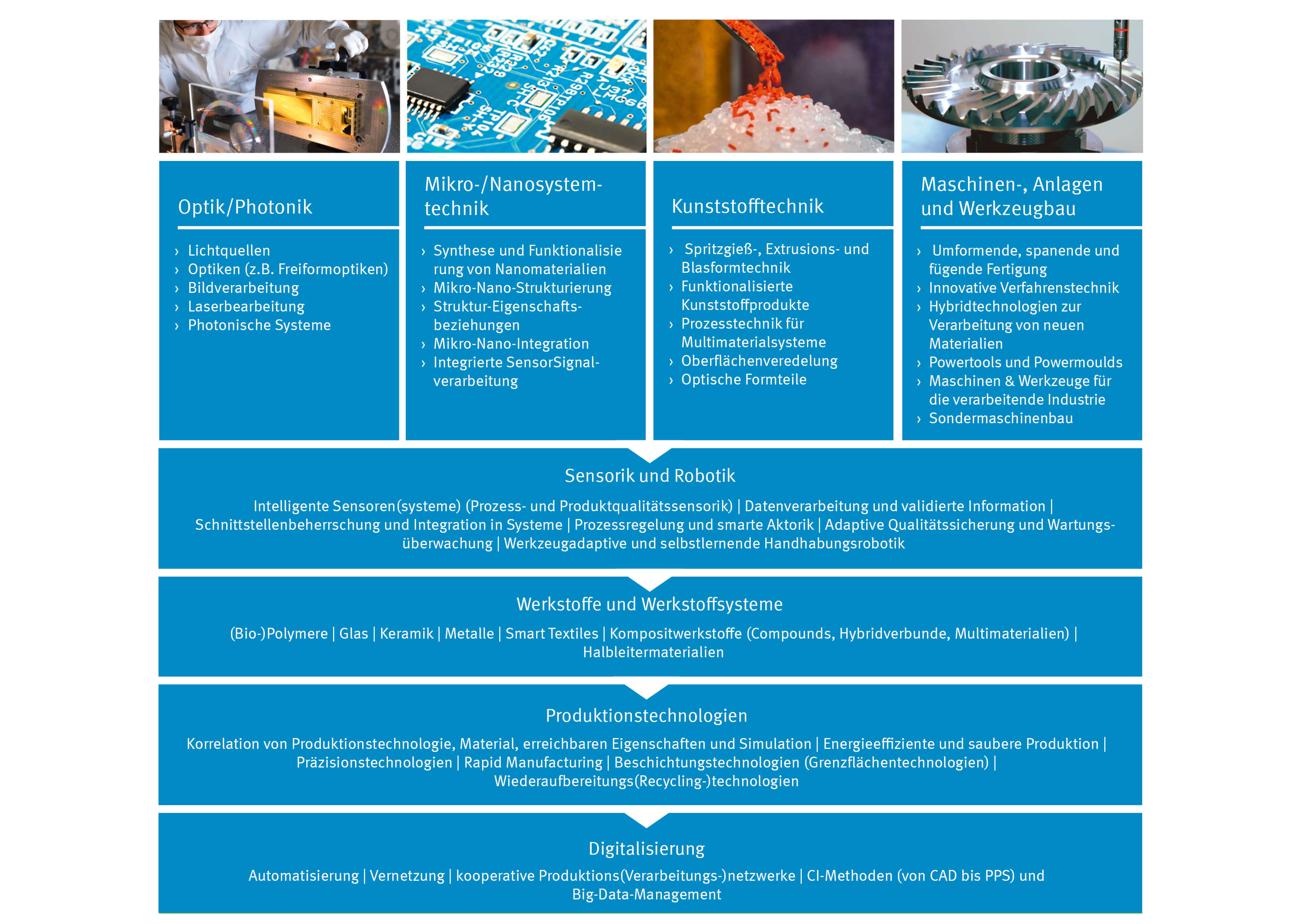
The Free State has a strong entrepreneurial base in the areas of manufacturing technology, plastics processing industry, mechanical and tool engineering, measurement, control and regulation technology, micro and nanotechnology, optics/photonics, sensor technology and robotics, as well as materials and material systems. Scientific expertise is particularly strong thanks to the seven Thuringian universities and 15 research institutions. It is closely interlinked with the Thuringian economy and is being increasingly expanded and supported by numerous research consortia, such as UKPiño and SAPHIR, as well as strong Thuringian innovation centers, such as ThZM or InQuoSens.
The Free State has a strong entrepreneurial base in the areas of manufacturing technology, plastics processing industry, mechanical and tool engineering, measurement, control and regulation technology, micro and nanotechnology, optics/photonics, sensor technology and robotics, as well as materials and material systems.
The scientific expertise is particularly strong thanks to the seven Thuringian universities and 15 research institutions. It is closely intertwined with the Thuringian economy and is being increasingly expanded – currently through two growth cores, a WIR.- and three RUBIN consortia in the implementation phase. Three further RUBIN projects have been positively approved and are in the concept phase.
Specialization profile for download
Specialization profile for download
The economy in the specialization field in figures



Data source: own calculation based on data from the TLS, as of 2023 (figures rounded)
Profile
Vision and goals
Thuringia is a technology-driven and internationally visible production region. Its success is primarily based on interdisciplinarity, competitive infrastructure, rapid market response, and innovative strength. In addition, there are other central guiding principles:
Cluster and Network Organizations
ELMUG eG
In the ELMUG industrial cluster, developers, manufacturers, suppliers, service providers, and research institutions of electronic measurement and instrumentation technology in Thuringia have come together. The goal is to expand and consistently develop one of Thuringia's core industries on a national and international scale.
Against the background of the increasing intensity of cooperation among the cluster members and the growing need to develop independent, economic activities, the cluster initiative was transferred into a legal entity on February 25, 2009, with the founding of the Elektronische Mess- und Gerätetechnik Thüringen (ELMUG) eG.
The purpose of the cooperative is the economic promotion and support of its members through joint business operations. The declared goal is to expand joint economic activity in order to consolidate the market success of the members individually and collectively, thereby opening up new market opportunities.

OptoNet e.V.
OptoNet bundles the interests of more than 90 players in the Thuringian optics cluster. The association promotes their networking and encourages cooperation with the aim of advancing the development of optical technologies in the region. At the same time, competitiveness is to be increased in order to expand the national and international visibility of the cluster. OptoNet sees itself as a service provider for its members, creates a common communication and cooperation platform and is actively involved in location marketing. Cooperation with regional, national and international networks of adjacent technology fields and with market-relevant partners is of particular importance.
In cooperation with OptoNet CoOPTICS GmbH, a wholly owned subsidiary of OptoNet e.V., a division of labor in the area of cooperation takes place. The GmbH focuses more on initiating, applying for, and accompanying research and development projects, conducts active trend and technology monitoring, and advises on financing options.

PolymerMat e.V. Kunststoffcluster Thüringen
PolymerMat e.V. bundles the interests of companies in the Thuringian plastics industry and works closely with regional networks. It offers a platform for communication and collaboration among companies in the plastics sector in innovation, product development, and the implementation of new technological cutting-edge achievements. All stages of the value chain are covered, from plastic preparation, processing, integration, and finishing to recycling, including tool and mechanical engineering.
In specialist groups and at events, the cluster maintains a lively exchange. Furthermore, the association is involved in public relations, corporate cooperation, the promotion of science, research and education, and the associated challenges of the need for skilled workers. As an interface between companies in the plastics industry and politics, the association contributes to the promotion of science, research, education and innovation. It also supports the development of the Thuringia economic region and the companies in the diverse application sectors of the plastics industry in the Free State.
FerMeTh Cluster for Manufacturing Technology and Metal Processing in Thuringia
This cluster brings together companies from the entire value chain of metal processing and mechanical engineering, as well as research and educational institutions active in the field of manufacturing technology. Currently, 18 members are organized (as of 08/15).
FerMeTh sees itself as a platform for comprehensive cooperation between companies, particularly in the field of research and development, in order to sustainably secure and further expand market opportunities and competitiveness – both regionally and increasingly in an international environment.
SmartTex Network Thuringia
Electrode shirts for measuring Trade Fairs body functions, textile solar cells, smart aids for people with disabilities – the SmartTex Network Thuringia advances new ideas, initiates cooperation projects, and organizes knowledge transfer between research and industry, e.g., through cross-sector workshops, seminars, and symposia. With the help of the network, existing research and development competencies are bundled so that good ideas for smart textiles can become marketable products more quickly.

SpectroNet
The SpectroNet network connects stakeholders in the field of visual quality assurance, based on digital color image processing and spectral imaging, across various areas and industries. SpectroNet offers both knowledge transfer and collaboration between research and industry, as well as the creation of system solutions for demanding image processing tasks and the development of market reserves. Another goal is to harmonize training and further education in this field and to define standards.

SensorikNet e.V.
detect puts sensors in focus. detect is the hub and mouthpiece of the high-tech sensor industry in the heart of Germany. detect is a value-creating network and represents the interests of its members from industry and research.

Cross-Cluster Initiative Thuringia
The Cross-Cluster Initiative Thuringia is a network of active networks from different industries.
Through the collaboration of cluster and network organizations, regular exchange of experience between the networks is to be ensured, current information for the management of the individual networks is to be made available, and research results are to be transferred more quickly into applications, products and services.
MiT - Material innovativ Thüringen
The platform "MiT - Material innovativ THÜRINGEN“ bundles and moderates diverse activities to further strengthen Thuringia as a competence region in the field of material development, production, and application. Supported by the voluntary, committed collaboration of many partners, it accompanies the implementation process of the Thuringian Innovation Strategy (RIS Thuringia), provides a topic-related discussion and collaboration platform, initiates/moderates material-related activities, bundles competencies, and ensures objective representation of interests.
Your contacts