

Look to the Stars
First Thuringian Aerospace Day in Jena: 300 representatives from business, research and politics discussed in Jena how Central German expertise in aerospace can be better pooled.
When people think of aerospace, they usually think of large aircraft manufacturers, rocket launches, or satellites in space. The state of Thuringia rarely comes to mind. Wrongly so: in the Free State, highly precise optics, sensors, electronics, and other key technologies are being developed without which modern aerospace would hardly be conceivable. The 1st Thuringian Aerospace Day brought these often hidden strengths into the spotlight for the first time and showed what potential Thuringia holds.
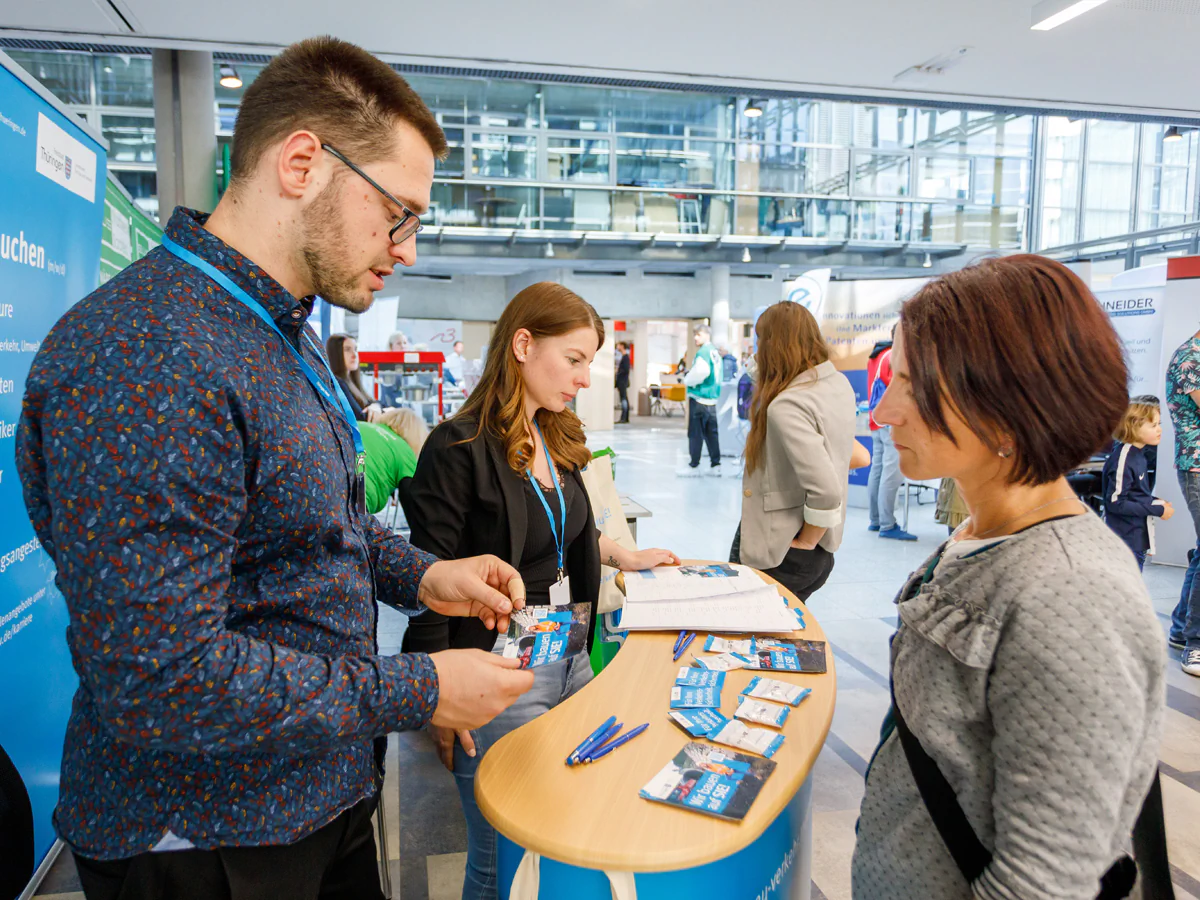
Around 300 participants, 39 exhibitors as well as numerous companies, research institutions and political decision-makers came together in Jena at the beginning of October to discuss the future of an industry that is on a growth trajectory worldwide. Together with the Competence Center for Aerospace Technology Saxony|Thuringia e. V., we as LEG Thüringen wanted to create a format that makes the industry's potential visible and connects important decision-makers more closely with one another. At the center of the day, for which we had invited guests to the congress area of the new Jena football stadium, was a central question: How can the existing competencies in Thuringia be used even more strongly for international aerospace in the future? And: How can other industries along the entire value chain also benefit from this in the long term?
Thuringia is not the classic aerospace location. But we possess numerous technologies and competencies without which modern aerospace would be inconceivable today. Optics and photonics, sensor technology and microelectronics, precision and measurement technology, materials processing, mechanical engineering, and digitalization are among the traditional strengths of our business and research location. We want to make these competencies even more usable for aerospace.
Strong competencies made in Thuringia
More than 100 companies and institutions in the Free State already develop or produce products related to aerospace today. Around 11,000 jobs are directly or partly connected to this technology field. Thuringia's research landscape, with several universities and institutions of Fraunhofer, Leibniz and the German Aerospace Center (DLR), also has numerous points of contact. These strengths were impressively demonstrated at the Aerospace Day.
Already in the morning, company and institute visits offered interesting insights into the world of Thuringian aerospace. In the afternoon, representatives from business, science, and politics then discussed current developments, challenges, and market opportunities in the industry. These are certainly available in several respects due to the potential use of many innovations as dual-use technologies with a view to the growing defense market. Currently, the space industry is also in strong competition among regions for the awarding of research and production contracts; worldwide, countries are competing with different intentions to open up and explore space and to write a new chapter in space history.
Thuringian technologies are already in demand in this race and are regularly used in international aerospace projects. For example, Jena-Optronik supplies star sensors that enable satellites and spacecraft to determine their orientation and position in space. Technology from Jena is also on board NASA's Artemis lunar program. In 2020, Jenoptik supplied optical technologies for a NASA Mars mission. The Fraunhofer Institute for Applied Optics and Precision Engineering (IOF) develops, among other things, high-precision optics and systems for satellites, Earth observation, and quantum communication. The Leibniz Institute of Photonic Technology (Leibniz-IPHT) was involved with sensor technology in lunar and Mars missions.
Thuringia also has established companies in the aviation sector. N3 Engine Overhaul Services in Arnstadt is a European competence center for the maintenance and repair of large Rolls-Royce engines. SOMAG AG in Jena develops highly precise stabilization systems for cameras and sensors, which are used in aircraft, helicopters, and drones, among other applications.
Identified: Opportunities for Growth
As the economic development agency of the Free State, we pursue the goal of strengthening future industries and further expanding the competitiveness of the location. The Thuringian Aerospace Day is the latest example of our aspiration. The event brought together stakeholders who in many cases are already working today on solutions for international aerospace applications. At the same time, new Contacte were formed between companies, research institutions, networks and political decision-makers. This very networking is an important building block for unlocking innovation potential and creating new value added for Thuringia. „The number of participants at around 300 as well as the total of 39 exhibitors show on the one hand that Thuringia is also a high-performance high-tech location with internationally visible expertise in this field; on the other hand, it becomes clear that our companies and industry stakeholders are seizing the great opportunities in this field“, explains LEG Managing Director Andreas Krey.
Tailwind for an industry with a future is also coming from politics: In addition to Mario Voigt, Minister-President of the Free State of Thuringia, and Elisabeth Kaiser, Minister of State and Federal Government Commissioner for East Germany, Thuringia's Economics Minister Colette Boos-John emphasized the opportunities that arise for the location.
Good economic prospects for the industry
According to the current “Employment Barometer 2026“ by EY-Parthenon, the aerospace and defense industries recorded the strongest employment growth among 19 sectors examined, at 4.3 percent. In total, 155 large listed companies from Germany, France, Italy, and Spain were examined for the study.
Impressions First Thuringian Aerospace Day


Comments
no comments available
Write a comment
Author