

InnoVIEW: Good idea, but who uses it? How PATON-PTH makes Thuringian university inventions visible
How do university inventions from Thuringia make it into practice? In the interview, PATON-PTH explains how patents are evaluated, protected, and marketed.
A technology that can split water into hydrogen and oxygen, developed at a Thuringian university. Technologically interesting, socially relevant, and yet the path from research to market is bumpy.
We learned why this is the case during a visit from Tino Rhein of the Patent Management of Thuringian Universities (PATON-PTH).
How does PATON-PTH decide which inventions have market potential, and what happens next?
At the universities, there is an enormous variety of inventions, and not all of them are project-related. Some arise from doctoral theses or are incidental results of contract research. The evaluation and exploitation of these free patents is the main task of PATON-PTH. We determine patentability based on a novelty search according to fixed criteria. For this purpose, we use various service providers, usually the research department of PATON. The result forms the basis for assessing the novelty of the invention. Regarding the question of the exploitability of an invention, we search for potential applications and users as well as possible business fields. This results in a recommendation for the university as to whether they should accept the invention and file a patent application for it or release it to the inventor. Only after a successful patent application does the focus shift to exploitation, i.e., we look for licensees or buyers for patents and, if applicable, also research or project partners for contract research.
Why do many good university inventions still not make it to the market?
Universities are sometimes many years ahead in certain technologies. It is rarely a finished product. Most technologies are at a maturity level of three to five. Companies often find it difficult to assess how they can participate in a technology that is not yet market-ready. Another hurdle is that universities and companies do not know about each other. A company is looking for a new welding process, and somewhere at a university there may be an invention that would fit exactly. In addition, universities mainly publish in their professional circles and do not communicate their inventions enough to the outside world. Linking all this information is a major problem and our task.
How do you find the company that matches an invention?
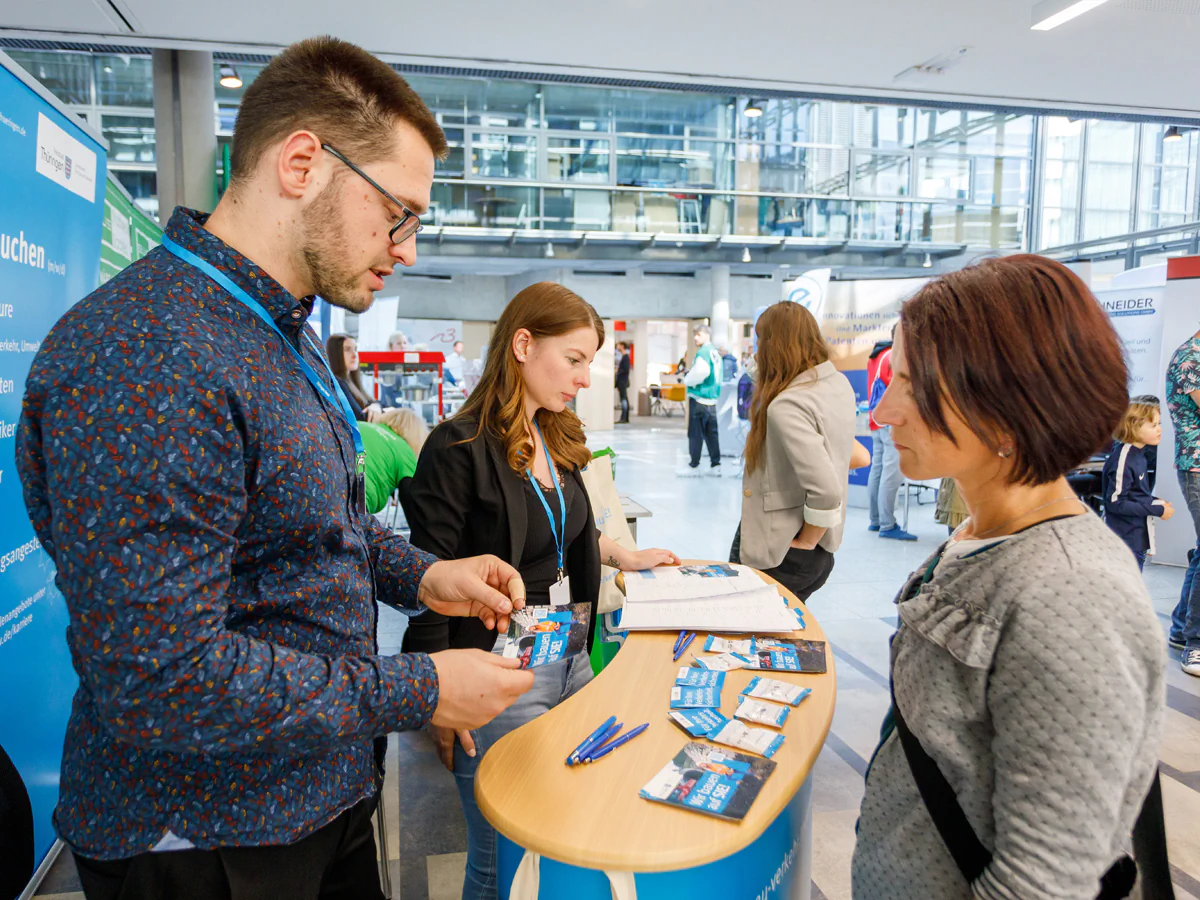
At PATON-PTH, we try to find exploitation partners as regionally as possible. We research on the internet and try to find matches with Thuringian companies. This does not always succeed. Therefore, we are represented annually at the joint booth "Research for the Future“ at the Hannover Messe or at the cooperation initiative of Saxony-Anhalt and Thuringia. Often, a concrete Contact arises from such a trade fair conversation. We also use the opportunity to go to trade fairs with the LEG on Trade Fairs to attend, for example, in 2026 with “smarter E Europe“ or “InnoTrans 2026“.
If the search for partners is not successful, we expand our search radius to all of Germany and finally also contact internationally active companies. For the latter, international patent applications would be interesting, which therefore do not only apply in Germany. However, the universities rarely have a budget for these expensive procedures.
From your perspective, where are the greatest opportunities for Thuringia and what still needs to be improved in knowledge transfer?
We have an enormous variety of inventions covering almost all research areas. One example from TU Ilmenau is a photocell, similar to a solar cell, that can split water into hydrogen and oxygen. Or the Bauhaus University has developed highly compressed straw building blocks as a sustainable alternative to conventional clay bricks.
The problem is visibility. In my opinion, the innovative capacity of universities is not presented well enough. Subject areas publish within their professional circles, but companies learn too little about it. Successful companies have understood that they need to draw attention to themselves. It is similar with universities. The inventions need to be communicated more strongly to the outside world.
What can endanger an invention even before the patent application?
Problems arise when information is published too early. In the worst case, a social media post or an interview can already cause the novelty to be lost and patenting to fail. A patent is also published after 18 months and is therefore visible to everyone. It is therefore important to know whether it is better to keep the invention technology secret.
So is a patent not always the best solution?
There are various patent strategies and one must weigh what makes sense for the respective invention. A patent can help determine the value of companies. If I do not protect important innovations, I may lose a competitive factor. Some technologies are better kept as trade secrets. At the same time, patenting, especially across national borders, as well as monitoring of protective rights, is expensive. One should therefore carefully examine which countries are relevant. PATON offers free initial inventor consultation by Thuringian patent attorneys.
What role do spin-offs and start-ups play in the commercialization of research results?
In the case of spin-offs, a patent can be the basis for a start-up. Especially when you want to transfer a technology from a university into a company, the intellectual property right is an important component. Patent commercialization does not always have to mean that an existing company takes a license, but rather that the invention leads to a spin-off, with its patent as an important foundation. A start-up can therefore build on an invention and the associated intellectual property right.
In which technology fields does Thuringia have particular potential?
We have a very broad range. Future topics such as energy, hydrogen, AI and health are of course particularly interesting. At Trade Fairs, one also notices that socially relevant topics are perceived more strongly, for example innovations in the energy sector or technical developments such as orthoses.
What role will AI play in patent exploitation in the future?
AI can be very helpful in research and finding partners. However, the actual evaluation and decision on the exploitation strategy remain a professional task. If an invention has not yet been published, we must not enter any information into external AI systems. There are internal solutions for this.
Can you name a specific success story where a university invention actually led to a product, a cooperation, or a spin-off?
A concrete success story is the exploitation of inventions for particle emission measurement, for high-precision measurement technology, and a passive exoskeleton for lifting operations, from which collaborations and marketable applications have emerged.
What trends are currently observable in patent exploitation?
A major trend is certainly that people are thinking more beyond mere patenting. It is not just about filing a patent, but about identifying potential markets and business fields, discovering development areas, and finding suitable companies. This also includes benchmarking and scoring.
What message would you like to give to Thuringian companies and researchers on their way?
To the researchers, I would especially say: Do not publish too early. First, have it checked whether an invention can be protected and which strategy makes sense. And to the companies, I would say: Look more closely at what is happening at the universities in the region. Many inventions are not yet a finished product. But that is exactly where the opportunity lies: companies can participate in the development and, together with the universities, turn a technology into something marketable. Patents are not just a protective instrument. They can secure competitive advantages, determine the value of a company, and form the basis for a spin-off or a cooperation.
Comments
no comments available
Write a comment
Author