

Thuringia digitizes the healthcare industry
Whether in more precise diagnostic tools or the optimization of hospital workflows – the application possibilities of AI in medicine are diverse. In Thuringia, companies and research institutions have specialized in developing and implementing tailored digital solutions for the healthcare sector. Furthermore, Thuringian hospitals are increasingly relying on AI-supported solutions to improve patient care and operational efficiency.
Whether in more precise diagnostic tools or the optimization of hospital workflows – the application possibilities of AI in medicine are diverse. In Thuringia, companies and research institutions have specialized in developing and implementing tailored digital solutions for the healthcare sector. Furthermore, Thuringian hospitals are increasingly relying on AI-supported solutions to improve patient care and operational efficiency.
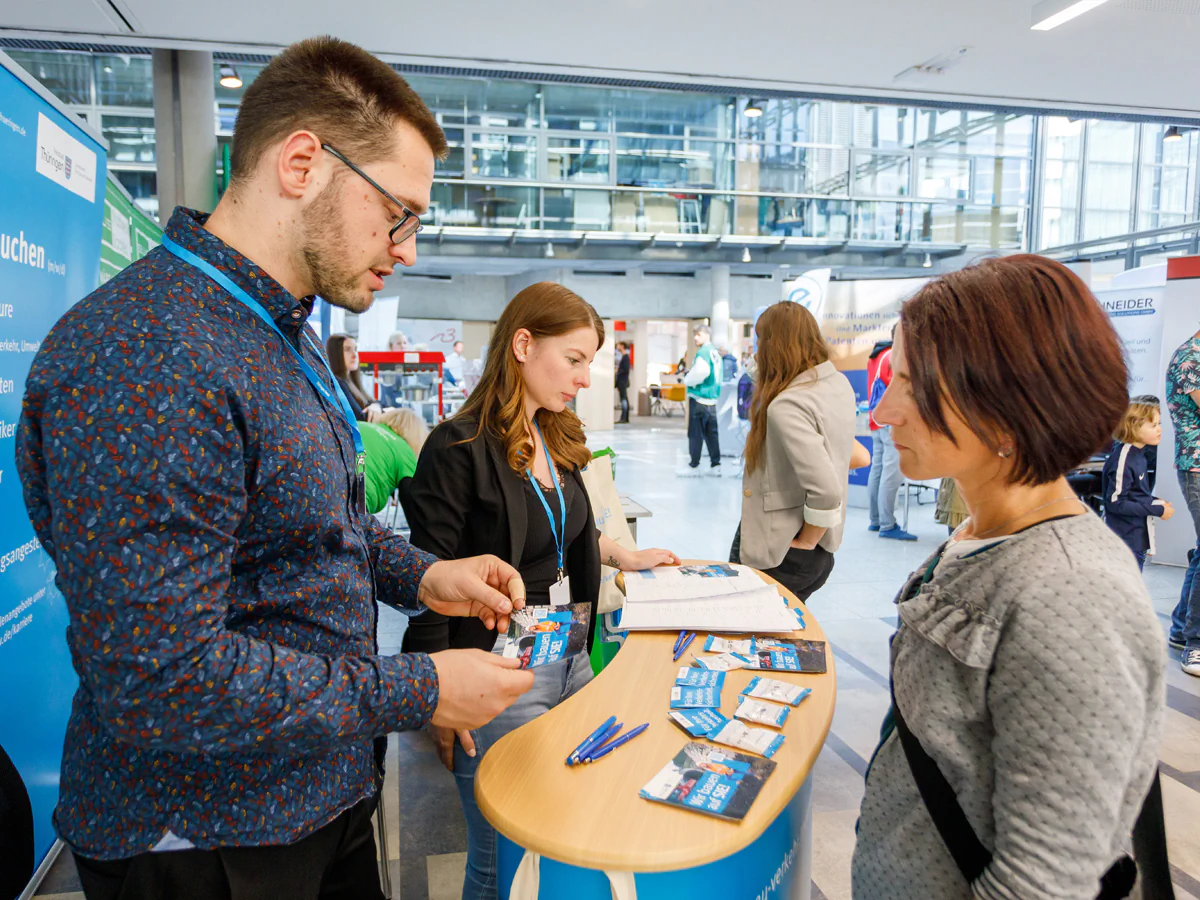
The InnoLOG “ICT meets Healthcare Industry” at the Technology and Innovation Park (TIP) Jena offered an excellent opportunity to experience the latest digital innovations in healthcare up close. Organized by ThCM, the event brought together leading players who are at the forefront of digital transformation in healthcare in Thuringia. In the following sections, we present some of the most exciting companies and initiatives and their innovative technologies.
1. Pioneering ICT innovations - Thuringian companies for the healthcare sector
Redwave Medical: Innovative Diagnostics for Cardiovascular Health
The Jena-based company Redwave Medical, founded in 2017, uses AI to improve the early detection of diseases. Their AI-powered algorithms provide innovative solutions for the medically accurate determination of health parameters for blood pressure, arterial function, and cardiac performance. In October 2022, the company was awarded the KfW Award Thuringia, underscoring their innovative strength and significance in the medical field.
DeepEn GmbH: Highly innovative holographic endoscopy technology
The startup DeepEn GmbH, founded in Jena in 2024, has developed a groundbreaking endoscope technology. Using a holographic modulator that precisely shapes light, the company enables the development of fine, high-resolution endoscopes that are particularly suitable for examining sensitive organs. With DeepEn's new ultra-thin microendoscopes, deep insights into the brain and other organs are possible with previously unattainable resolution and minimal invasiveness. The data is converted into a visible image for users through digital methods. By winning the special prize for young companies at the Thuringian Innovation Award 2024 and a seven-figure seed financing in 2025, the company is ready to bring its vision of high-precision, minimally invasive endoscopes to market by the end of 2025.
Bright Giant: AI-powered mass spectrometry for metabolic analysis
Bright Giant GmbH optimizes the analysis of metabolic processes using AI-supported mass spectrometry. Their innovative solutions enable a more precise and faster analysis of metabolic changes, driving the development of new diagnostic tools and therapeutic approaches in the field of medicine.
Quantifisens: Quantum Technology Meets Measurement Technology
QUANTIFISENS is a research alliance specializing in the development of innovative fiber-optic sensor solutions. Using cutting-edge quantum technology and advanced measurement techniques, the project aims to create highly precise, minimally invasive diagnostic solutions. These technologies, which are particularly applied in precision medicine and endoscopy, enable improved patient care through detailed, radiation-free diagnoses. The project is supported by funding of around twelve million euros from the Federal Ministry of Education and Research.
2. AI in Thuringian Hospitals: Insights into Practice
Thuringian hospitals are increasingly relying on AI-supported technologies to optimize patient care and operational processes:
Early diagnosis: AI-powered image processing improves disease detection and enables early intervention. At Jena University Hospital (UKJ), AI has been used since 2019 to analyze medical images from computed tomography (CT) and magnetic resonance imaging (MRI).
Optimized processes: Automation of administrative tasks and patient management through AI increases efficiency, for example through improved demand forecasts for blood supplies, optimized schedules, and easier coordination of patient transports. As part of the BMBF junior research group KI-LoV, UKJ Jena is currently researching how data-driven models can make logistics in healthcare more efficient.
AI, Automation/Robotics and System Integration: At the Ernst-Abbe University of Applied Sciences Jena, the automation and development of robotic assistance systems in hospitals is being advanced for more precise surgical interventions and to relieve medical staff. IKT-supported solutions such as intelligent prostheses and exoskeletons are also gaining importance in rehabilitation. Virtual health assistants and remote monitoring systems further enhance the quality of care.
3. Overcoming the Challenges in the Digitalization of Healthcare
Digitalization in healthcare offers enormous potential, but to successfully leverage these opportunities, regulatory hurdles must be overcome and data protection concerns addressed. An important measure to master the legal framework is targeted training for medical staff. This helps to understand and safely apply complex regulations.
At the same time, the use of anonymized or synthetic data opens a path to drive innovation without compromising patient privacy. An outstanding example of this is the AVATAR-project in Thuringia, which aims to convert real patient data into digital avatars so that the data can be used in a data protection-compliant manner.
The introduction of digital solutions in healthcare also requires reducing acceptance barriers and expanding digital competencies. This can be achieved through practical demonstrations that show the benefits of the technologies in real-world use, clear communication about the advantages and functionalities, and targeted training. Uniform data standards and close cooperation between providers are also essential to fully exploit the potential of digitalization.
Conclusion
The digital solutions presented as part of the InnoLOG impressively demonstrate how Thuringian companies are improving patient care and increasing the efficiency of healthcare processes. Even though digitalization in healthcare still faces challenges – for example regarding data protection – it is clear that Thuringia is well equipped to overcome these hurdles. Ultimately, digital transformation in healthcare is not just a goal, but an ongoing process in which Thuringia will play an important role.
Comments
no comments available
Write a comment
Author