

Strengthening the Thuringian semiconductor ecosystem
Together for a strong Thuringian semiconductor ecosystem: In several workshops, stakeholders from business, science, and politics develop new impulses for the future of the industry.
Strengthening the Thuringian semiconductor ecosystem: Through visibility and networking, funding, land availability, and securing the workforce
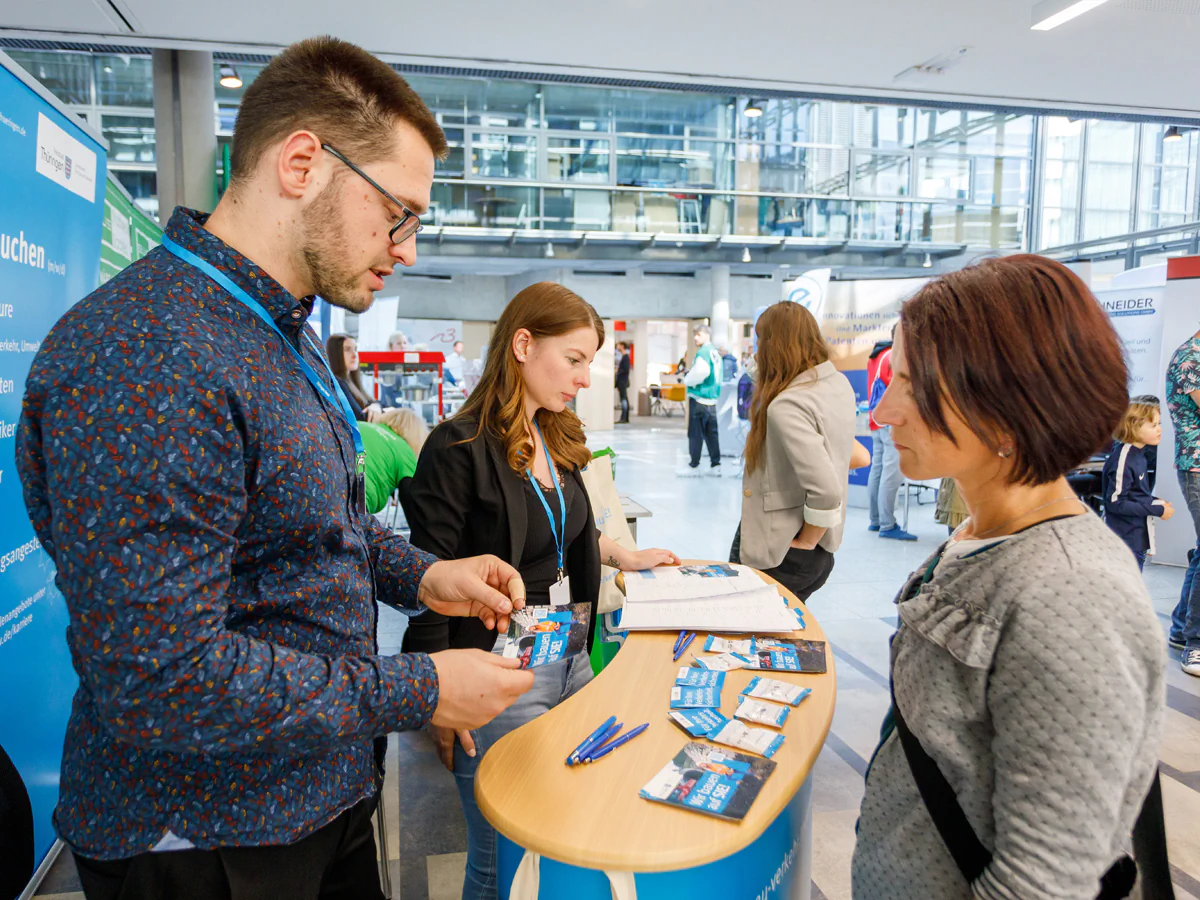
As part of four thematic workshops to strengthen the Thuringian semiconductor ecosystem, the topic of "Workforce and Skilled Workers“ was taken up on April 23, 2026 at TU Ilmenau. Around 40 experts from companies, universities, research institutions, and politics exchanged views on current challenges and possible solutions. Previously, the fields of action "Visibility and Networking“ and "Support and Promotion“ were discussed in interactive and insightful events.
The aim of the workshop was to jointly analyze the current and future skilled labor situation in the semiconductor ecosystem and to derive concrete ideas and action proposals for securing skilled workers. At the same time, the event served to further deepen cooperation between companies, universities, research institutions, education and transfer actors, as well as policymakers.
Together with the Thüringer Initialkreis and the TMWLLR, on whose behalf we organize the workshops, we are driving the process forward to further expand Thuringia's expertise in the key technology of semiconductor technologies and to strengthen regional value creation.
Common lines and key findings
The workshop examined the topic of labor and skilled workers from different, complementary perspectives: from a labor market economics perspective, from higher education and training practice, as well as from an entrepreneurial and HR strategic viewpoint. Taken together, they paint a clear picture of the workforce-related challenges for the Thuringian semiconductor ecosystem.
1. Labor Market in Structural Change: Understanding Long-Term Dynamics
The labor market is undergoing a profound and lasting structural change. Four key drivers shape this development: demographics, digitalization, de‑fossilization, and de‑globalization. These factors act simultaneously and reinforce each other, but also open up significant room for maneuver for those who actively and early shape the change.
For Thuringia, this means in particular a decline in the labor supply due to demographic aging, while the demand for qualifications is rising significantly. Digitalization leads less to job cuts than to intra-occupational change that requires higher qualifications. The transformation towards a climate-neutral economy further increases the need for skilled workers, especially in technical and engineering-related fields. At the same time, geopolitical developments and fragile supply chains are changing location conditions and increasing pressure on regional value creation.
Key consequence: Securing skilled workers is not a short-term measure, but a strategic permanent task that must integrate training and further education, integration, productivity, and social security.
2. Training, universities and location factors: From knowledge to employability
The workshop results show that the demand for skilled workers in microelectronics is not just a matter of expertise. Particularly emphasized were long training periods, the need for specialization and practical experience, as well as the ability to handle technical tasks independently and in a structured manner. What is sought are graduates who combine technical fundamentals with problem-solving skills, learning ability, and an understanding of industrial work processes.
The results show that training and industrial practice in microelectronics need to be more closely aligned. Curricula that are too theoretical, low practical content, little project work, and insufficient integration of disciplines make the transition to professional practice difficult. The need for a stronger system understanding, methodological competence, and interdisciplinary training was particularly emphasized.
Key levers identified were raising students' awareness of the industry's attractiveness, early and close industry links, practice-oriented study formats, and joint projects to better utilize local potential. In addition, the structured integration of international skilled workers was highlighted as an important component, while simultaneously ensuring quality. Schools were identified as the central first point of contact, while universities should see themselves even more as part of the industrial ecosystem.
Furthermore, it became clear that location factors also play a significant role in attracting skilled workers. In particular, the rural character of individual locations can pose an additional challenge for young people. Mobility options must be created, especially in peripherally located areas.
3. Companies in Crisis: Trust, Loyalty and Employer Image
The third impulse brought the perspective of companies in economically tense times. Uncertainties burden both businesses and employees alike. In this situation, the employer image becomes a decisive stability factor.
Central to this is internal communication. Regular updates, personal conversations, and transparent decisions are essential to maintain trust and reduce uncertainty. At the same time, the virtual perception of companies is gaining importance, for example through online platforms and social media. Employer attractiveness does not disappear in times of crisis, but it becomes visible in a different way: through reliability, fairness, and comprehensible actions.
Crisis times therefore require particularly careful personnel planning. The results show that companies should develop clear roadmaps early on, communicate openly, and strategically review new appointments. Even if economic downturns limit room for maneuver, further training, talent pools, and employer communication remain important tools to keep the retention of skilled workers and future viability in sight.
In addition, there was a concrete insight into securing skilled workers from a company perspective. It became clear: sustainable securing of skilled workers begins early, for example through student internships, training and close Contacte to universities. At the same time, loyalty does not only arise with the employment contract, but through good support, development opportunities and satisfaction in everyday working life. Especially with a view to the generational change, the recruitment of young talent, knowledge transfer and corporate culture must be considered together.
This made it clear: securing skilled workers is not a single measure, but a joint task along the entire education chain and across the entire employee cycle.
The next stage will be the final workshop on the topic of "Land Availability" at the beginning of summer.
The stakeholder process is to be consolidated at the end of 2026 in a cross-cutting event with concrete proposals for improving the framework conditions for the semiconductor location Thuringia as well as new impulses.
Comments
no comments available
Write a comment
Author