
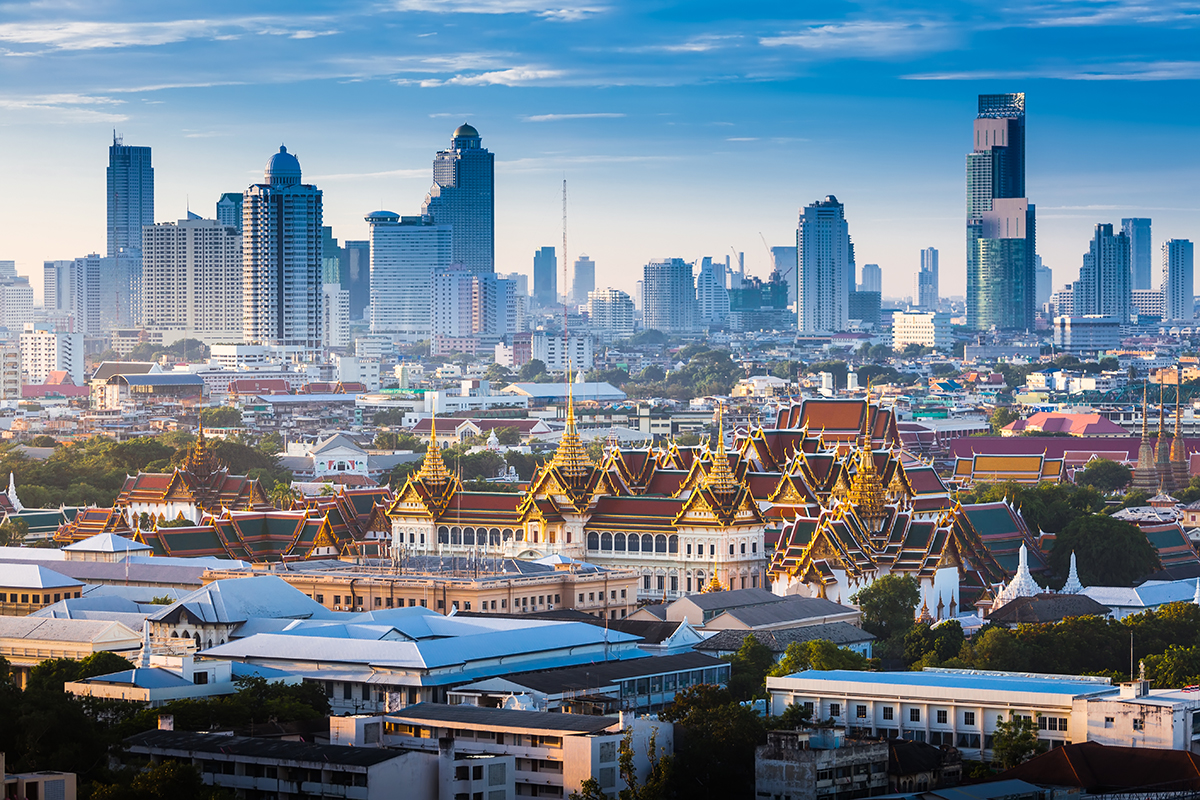
For the period from October 4 to 10, Thüringen International, together with the IHK Südthüringen, is planning a business trip to Vietnam and Thailand. While market support for Vietnam has been a focus of Thuringia's international activities for some time, Thailand has been less represented in this context so far. The stops of the two-day market exploration in Thailand will be Bangkok and the so-called Eastern Economic Corridor (EEC) – a special economic zone for the high-tech sector that encompasses the three provinces of Chonburi, Rayong, and Chachoengsao. Reason enough to take a closer look at the potential market of Thailand.
With its over 70 million inhabitants, the Southeast Asian country has the largest industrial share of economic output among the ASEAN countries. After very high – in some cases double-digit – growth rates in recent decades, the country is currently experiencing GDP growth that is rather moderate in regional comparison. This year, it is expected to be 1 to 2 percent. In the competition for foreign investment, the country is also increasingly competing with other ASEAN states, such as Vietnam. China is Thailand's most important trading partner and largest investor. Nevertheless, the country tries to maintain a geopolitical balance in its dealings with the major powers.
In addition to automotive production and the chemical industry, food processing – Thailand is one of the largest exporters of food – and the electronics industry are among the most important industrial sectors. The electronics industry is also the country's most important export sector. In the service sector, tourism is the main pillar and an important source of foreign currency. A driving force of the economy is the booming foreign trade, which has grown by 50 percent over the past five years. However, the high foreign trade ratio and tourism make the country's economy dependent on international developments.
As an ASEAN member, Thailand is already integrated into intra-Asian free trade. The RCEP agreement (Regional Comprehensive Economic Partnership) additionally enables trade facilitation with strong partners such as China, Japan, South Korea, Australia, and New Zealand. This significantly increases integration into the global economy and international supply chains. And the signs point to further expansion. New impetus is expected in the future from a comprehensive trade agreement between the EU and Thailand. However, the contract negotiations for this are still ongoing.
The Thai government has recently approved a multi-billion euro economic stimulus and aid package to compensate for the effects of the Iran war. The blockade of the Strait of Hormuz had severely impacted the country's energy imports.
For Thuringian exporters, Thailand is fundamentally a very interesting, albeit selective, growth market. Opportunities exist primarily in technologically demanding niches. For example, in the field of mechanical and plant engineering, Thailand mainly demands high-tech machinery, which is needed in large numbers for the restructuring of production processes. Companies from the Free State exported goods worth over €80 million to Thailand last year, while goods worth over €50 million were imported.
Further information on the planned business trip will soon be available on our website. You can already register without obligation here carry out. You will then be automatically informed about updates and the later binding registration.