
The very first test image that the telescope sent to Earth in March after its launch in December already amazed researchers: After the 18 mirror segments were correctly aligned, the new space telescope, which is considered the successor to the Hubble Space Telescope, which has been stationed in space since 1990, sent an image of a spiky star with numerous previously invisible galaxies to Earth. A sensation that gives hope for further spectacular images and thus for answers to how the universe once came into being and: whether there is actually life in space or habitable planets. A total of four scientific instruments are on board the telescope. Of these, the »Mid InfraRed Instrument« (MIRI) is equipped with mirrors that were manufactured at the Fraunhofer IOF in Jena. These ultra-precise mirrors were diamond-turned and coated here. Diamond turning is a powerful manufacturing process for producing such planar and curved optical surfaces. But MIRI is not the only instrument that was made ready for the mission with the help of Jena expertise. Jena researchers were also involved in the realization of the “Near Infrared Spectrograph“ (NIRSpec). NIRSpec acts as a kind of super-eye of the space telescope and can analyze light in the wavelength range from 0.7 to 5 micrometers. (gro)
Jena precision optics conquers space
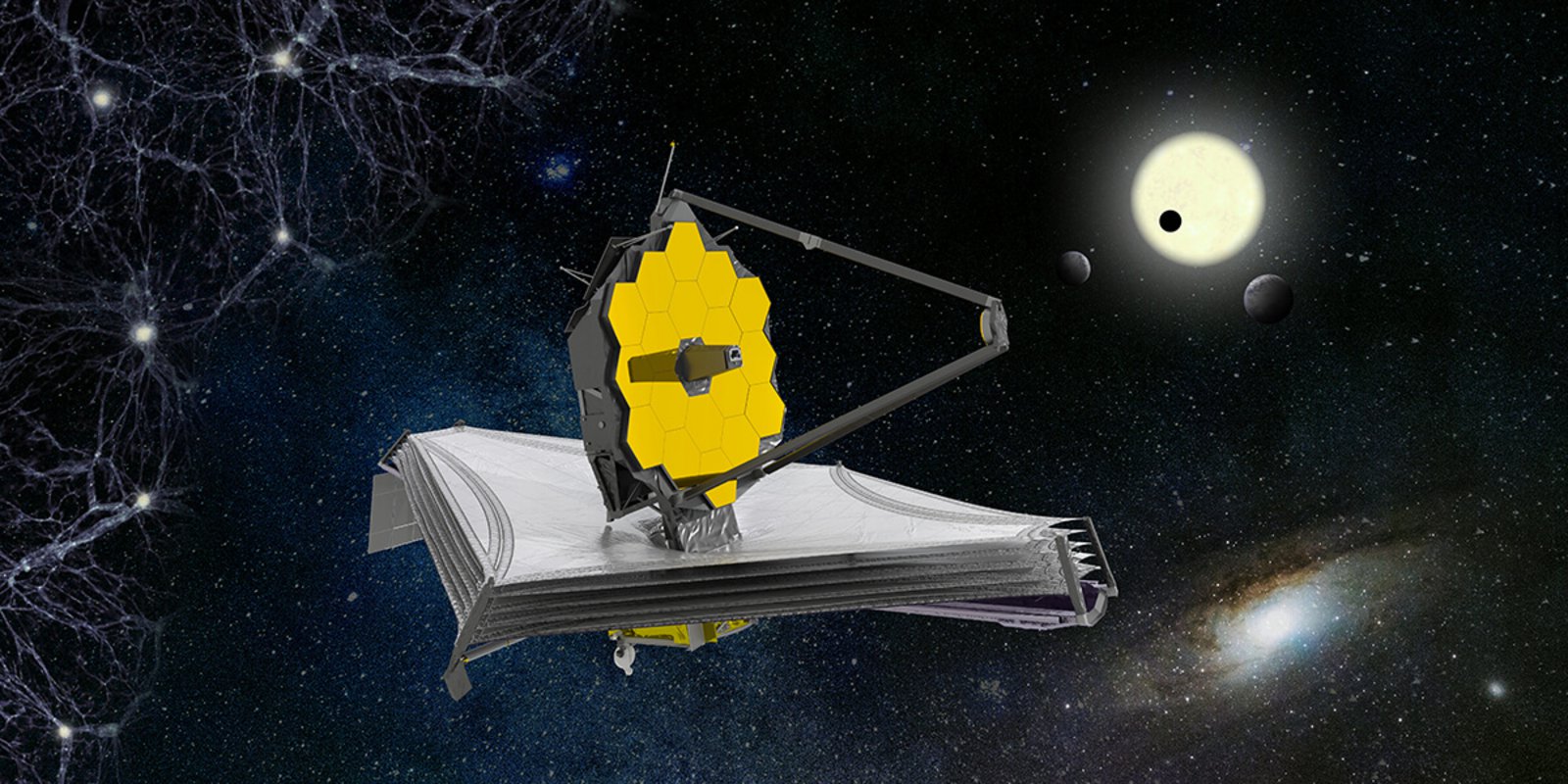
Visualization of the James Webb Space Telescope, which is intended to look deeper into space than any other space observatory before. Image: ©ESA/ATG medialab/Fraunhofer IOF
Share this article: