
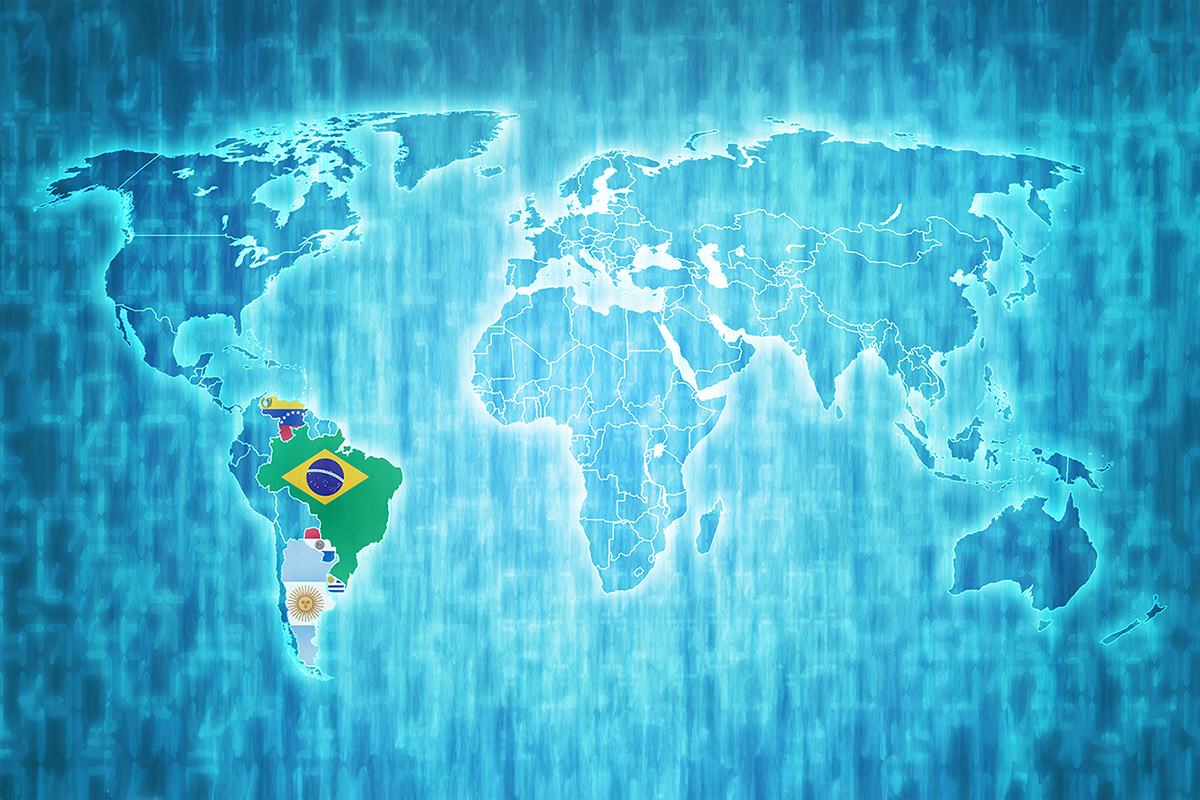
The EU-Mercosur free trade agreement has been regarded for years as a beacon of hope for closer economic cooperation. After around 30 years of intensive discussions, the agreement was signed in 2024, but has not yet been ratified. Some member states still have concerns and are blocking the final decision. Nevertheless, experts see enormous opportunities in its implementation: the integration of value chains, the protection of European geographical indications, and stable rules in a geopolitically uncertain world are among the key advantages.
In this compact, one-hour event, our foreign representative in Brazil, Dietmar Sukop, and Carl Moses, advisor for business, politics, and trade in Latin America, discussed the economic framework conditions and market opportunities in Brazil and Argentina for German companies: Interesting insights into the economic framework conditions and market opportunities of both countries were provided, as well as all relevant information about the agreement and its impact on German entrepreneurs.
Key Takeaways (the full interview follows below):
- Brazil remains the largest economy in Latin America and ranks among the top 10 worldwide. Despite global uncertainties, GDP is growing, inflation stands at 4.3%, and unemployment is low at 5.5%. For German companies, exciting opportunities are currently opening up in key sectors. Investments in agribusiness and food processing are particularly attractive, as they are considered driving growth factors. Renewable energies and projects around green hydrogen are also gaining increasing importance. Another strategic area is the extraction and processing of rare earths and lithium, which are indispensable for high-tech applications and electromobility. In addition, industrial automation and mechanical engineering offer great potential.
- Under President Javier Milei, Argentina is experiencing profound reforms. Inflation has fallen from several hundred percent to below 30 percent, a historic success that provides planning certainty. Diverse opportunities are also emerging here, especially in the supply of raw materials, which offers a stable basis for industrial value creation. Major projects in the energy and infrastructure sectors are also particularly interesting. The steady growth in demand for high-quality products generates attractive export opportunities for Thuringian companies. A major advantage of the Argentine market at present is the favorable exchange rate and the high purchasing power in US dollars. For German companies, a market is opening up that was completely closed to many for a long time due to import restrictions, and now the doors are wide open.
The following is the complete interview conducted as part of the online event "Café International: EU-Mercosur Free Trade Agreement“ on December 3.
Carine Cornez-Fliege:
With this conversation, we would like to gain an understanding of the current situation in Argentina and Brazil and answer the question of how things will proceed with the Mercosur-EU free trade agreement and what will happen if it does not come about.
To begin with, it would be good if we could get an overview. Dietmar and Carl, please give us a brief update on the current economic situation in Brazil and Argentina.
Dietmar Sukop:
(…) we actually still expect a slight increase in gross domestic product this year as well. Unfortunately, this was revised slightly downward over the course of the year, also in the wake of the tariffs from the USA. As you may know, the Trump administration imposed punitive tariffs of 50% on all exports, or almost all exports, from Brazil. Brazil is also currently in contact with the Trump administration, so President Lula is in communication with Trump, and there is an exemption list.
(…) The USA have already made some concessions, also on many agricultural products or food items, coffee, orange juice, for example. But there is at least the prospect that these 50% import tariffs on Brazilian products will be reduced somewhat again. As far as inflation is concerned, we are still somewhat outside the target range that the government has set for itself, currently at around 4.3%. Now, at the end of the year, we still have very high financing costs due to a very high key interest rate. So it is difficult for new investors to invest in Brazil.
On the unemployment figures side, we are currently at about 5.5% on average across Brazil. Some federal states even have almost full employment. For example, Santa Catarina, which at 3% practically already has full employment. So the population is actually doing quite well. And as already mentioned, the gross domestic product is rising slightly, which also ends up in consumers' pockets. So the available amount of money per year, i.e. gross domestic product per capita, we are also at about 10,600 US dollars, which is actually relatively good compared to the average of recent years.
Carl Moses:
It has never been as exciting in Argentina as it is now, in the two years since Javier Milei won the election. And since then, everything has been in motion. As is widely reported, Milei has implemented radical adjustment measures in the finances. At the same time, he is a pragmatist who, for example, has so far adhered to managing the exchange rate, contrary to his libertarian ideology. So, he proceeds very pragmatically with his team, which he has assembled from other political parties and institutes.
(…) Inflation, by far Milei's biggest and most visible success so far, has fallen from several hundred percent to under 30 percent per year. Two percent per month is still a lot, but for Argentina it's a real improvement because people can simply plan. It's just a bit more stability. And Milei continues to do everything he can to keep inflation under control. At the same time, however, it is known that a lasting decline in inflation is a process that takes years. Look at countries like Peru, Uruguay – there was hyperinflation and high inflation throughout the region in the past. It took many years, also in Brazil, to truly reach that stability. And that cannot be conjured up in Argentina either.
But something else has changed: As I said, in the last election in October, his party was unexpectedly strongly confirmed.
And more importantly, in my opinion, what we have experienced in recent months is the absolute backing of the United States, namely the government of Donald Trump and his Treasury Secretary Scott Bessent. The Trump administration will remain in office for a few more years, which is always necessary to support Javier Milei and his reform course.
Carine Cornez-Fliege:
More stability, that is also important for the individual entrepreneurs, who themselves can finally plan a bit more long-term again?
Carl Moses:
Milei has indeed liberalized many import barriers, especially non-tariff barriers, and access to foreign exchange for imports to a very large extent. This means companies again have access to foreign currency to be able to import, and imports have risen massively this year and last year. At the moment this year, the economy is flat, I would say. So there has basically been stagnation since February. Nevertheless, the country will post average growth of around 4% for 2025. But that is the carryover from the recovery in the second half of 2024. That means next year we will probably have average growth of below four percent. But people will still feel that the economy is picking up because the situation is improving month by month. And imports are open, wide open. And the purchasing power of Argentines in dollars is high because the government continues to keep the dollar exchange rate stable and as an important anchor for inflation. Argentina is too expensive, definitely. But the government refuses to make any changes to its exchange rate policy and is betting everything on the country becoming more efficient and productive. But we all know that takes a long time. It cannot happen within a few months. It is indeed a very dynamic, very exciting development. So far, Milei has the support of the majority in Argentina, and, as I said, he has above all this tremendous support from the USA. With that, I believe he can keep the situation stable in the second half of his term. But what exactly will come next will remain extremely exciting in Argentina. But after the last two or three months, I am significantly more optimistic, also regarding the medium and long term. For German companies, this is great news, because a market is opening up that was completely closed to many for a long time due to import restrictions, and now the doors are wide open. And it will also be very interesting for direct investment.
Carine Cornez-Fliege:
We had high hopes at the end of 2024 when the EU-Mercosur free trade agreement was finally signed. It was said that it would come and that we could look forward to it. Now a year has passed and it has not been ratified.
How is the situation? What do you think? We hear that Lula wants to give us a gift for Christmas and that it will be signed. What is your assessment?
Dietmar Sukop:
Yes, as you just said, Lula wants to sign the agreement on December 20th. Whether it will actually happen, I can't tell you. I think, after all these years behind one, one has become a bit pessimistic about the real conclusion as well. Here one must also distinguish between two different conclusions.
There is the trade agreement alone and the complete EU-Mercosur agreement, which then also has to be ratified by the individual EU countries. The first trade agreement is of course a bit simpler. It only requires the signature of the EU Parliament. If we can sign this trade agreement first, that of course does not mean that tariffs will be set to zero overnight, but rather that is of course a long-term development that lies ahead of us, up to 15 years in some cases, during which tariffs will then also be reduced.
The farmers also fear that cheap agricultural products might eventually come to Europe. Personally, I see no problems there. Every company, for example, that exports meat from Brazil must be certified and must be sustainable. For me, there is no danger that cheap meat or rotten meat will somehow come to Europe. But on the other hand, the farmers in Europe naturally have a justified fear of being exposed to very strong competition.
On the other side, of course, the Brazilian industry also had certain concerns: now technologically high-quality equipment and machines are coming from Germany. And we in our companies really have to look around to make sure we can cope with this enormous competition. There will certainly be losers, as in every process, every agreement, or every economic and political process, and some companies will fall by the wayside. Certainly, some agricultural companies in Europe will also fall by the wayside. But I think the important thing is that the economy, from a macro perspective, benefits from it, and the population, the general population in both regions, will also benefit from it.
Carl Moses:
So, I have been reporting on the development of relations between the EU and Mercosur for 30 years, and with great commitment too. I have at times been almost activist in my support for the agreement. For some years now, I have only reluctantly looked at the development, because I am simply annoyed that, firstly, we obviously cannot get it together, and it is the EU's fault. It has been the EU's fault for quite some time, and not the South Americans', that it is not coming into force. And by the way, negotiations are currently underway with the USA. And they will probably decide as early as the end of this week to open their market in a similar way. In contrast, there is a fallow supermarket landscape, at least in Argentina, where processed products are terribly expensive. Where even German jam, if it costs three times as much as in Germany, is still competitive on Argentine supermarket shelves. That Mercosur protects 300 designations of origin such as champagne and Black Forest ham and certain types of cheese. The EU has enormous potential in processed food products, and it is crazy that we always only talk about glyphosate and a few tons more or less of meat or ethanol, and not about these opportunities. Quite apart from that, I believe that we also need the agreement because, in the current geopolitical shift, international rules are collapsing before our eyes. And with the EU-Mercosur agreement, we can at least maintain stable rules within this area, which would be the largest economic zone in the world, as we are used to them, and we would even have them better than before. For me, it is simply no longer comprehensible that we still have not brought it into force. (…)
I fear that we are already too late, regardless of whether the EU-Mercosur free trade agreement is actually signed on the 20th or not. China has long since overtaken us. The USA is currently marching massively ahead in Argentina, as I just said. And that is only the bridgehead for the entire region. Lula and Trump also seem to get along well on a personal level. All of this is slipping away from us. So we are stagnating and falling relatively behind if we Europeans do not move.
Dietmar Sukop:
And I actually also think that the opportunities for European companies are much, much greater than for South American companies. So the tariffs, for example, that currently exist in the EU are far less than what is demanded here in Mercosur. And of course, what is to be introduced in terms of tariff reductions is also much, much greater on the Mercosur side. So it will become much, much easier to export to Mercosur. And on the other hand, the tariffs that may be eliminated in the EU are much, much lower. So the advantage clearly lies on the European side.
Carine Cornez-Fliege:
Suppose the EU-Mercosur free trade agreement is not signed. What chances do we still have?
Carl Moses:
In Argentina, the agricultural industry has always been the backbone of the economy, generating all the foreign exchange that the rest of the country needs to keep the economy running at all. In addition to this still extremely dynamic sector, there is the question of currency: Where are there better delivery opportunities for Germany than before, precisely because non-tariff trade barriers have been reduced and dismantled, and because the peso is strong. Sometimes it is much more important to look at how the currency is moving. If Argentina has a totally overvalued currency, then they can buy anything. Customs duties then no longer play such a big role.
Further opportunities exist in the supply of raw materials, where Argentina is on its way to becoming a truly significant player for lithium, but also for copper, where German companies could and should secure their raw material supply before this is lost to China or North America. (…) Argentina is now really set to develop its shale gas reserves with all its might. These are huge projects, for which there is also a promotion regime that was also legally adopted under Milei, which thus grants great advantages and long-term guarantees for large projects in the energy, infrastructure, or mining sectors.
That means, when such a mining project is developed for several billion dollars, then for hundreds of millions of that, the technology largely comes from Germany. So at that level, very concrete and very large business opportunities are now emerging.
I have just mentioned the terrible undersupply in the breadth of the product range in Argentine retail – the imports are open. Also, the testing procedures have been simplified. If a battery is approved in Europe, you do not have to have it tested again in Argentina before importing it. So, the doors are wide open, I can list all of this, because it applies to all economic sectors where Argentina is a grateful buyer. It should be used while this exchange‑rate relationship is so favorable . At the moment the window is open.
Dietmar Sukop:
I am still optimistic that the agreement will be behind us at least by the Hannover Messe, where Brazil is the partner country. But if not, just like in Argentina, the economic engine is the agro-industry, meaning not only actual agriculture but also agribusiness in general: agricultural technology, food processing, and similar fields. That is the engine of the Brazilian economy.
The topic of lithium and rare earths themselves was also already addressed by Carl; the Trump administration is of course also interested in this. It is also approaching Brazil in order not to set imports too high and to hope that Brazil will be one of the suppliers of rare earths to the USA and that these will not only go to China. By the way, China is Brazil's most important trading partner, and if China now also enters this sector, then it also looks bad for the European Union.
As Carl already said, there are so many suppliers. Green hydrogen is another topic where things are stalling a bit. German companies and German politics could also do something here to play a major role a bit further ahead.
Carl Moses:
With the EU-Mercosur free trade agreement, we would at least have a set of rules from which small and medium-sized enterprises in particular would benefit, which do not have their own branch on site. Corporations and large companies handle this internally, but it would be extremely helpful for mid-sized companies. I always say, we do not necessarily need the EU-Mercosur free trade agreement, but it would help us, and it would move us forward and it would prevent us from falling behind in competition with China, but above all also with other countries from Asia and other regions.
We have an excellent position; Germany remains the country with the most direct investments in Mercosur. But momentum is now needed, and I think what Donald Trump is doing shows us, on the one hand, that the fight is being waged with tough tactics, but on the other hand, that this great support from the USA for Argentina is now coming, as they had announced a year ago. The Americans guarantee the stability of this ally, and we also benefit from that because the conditions have become better and more stable.
Carine Cornez-Fliege:
Thank you for the interesting conversation.
Argentina and Brazil are currently changing rapidly – and with or without the EU-Mercosur agreement, new opportunities are emerging that one should be aware of. We are available for this and are happy to establish the Contact to market experts such as Dietmar Sukop and Carl Moses.